Conversation
Notices
-
Embed this notice
/b/ (slashb@fsebugoutzone.org)'s status on Sunday, 19-Oct-2025 19:10:38 JST  /b/
/b/
1760813764532642.png- pistolero likes this.
-
Embed this notice
pistolero (p@fsebugoutzone.org)'s status on Sunday, 19-Oct-2025 19:26:40 JST
pistolero
@phnt @slashb
disable_ipv6.jpg✙ dcc :pedomustdie: :phear_slackware: and Blurry Moon like this. -
Embed this notice
Phantasm (phnt@fluffytail.org)'s status on Sunday, 19-Oct-2025 19:26:41 JST  Phantasm
@slashb
low-quality-bait.jpg✙ dcc :pedomustdie: :phear_slackware: and pistolero like this. -
Embed this notice
KIRBY!! :pleromatan: (kirby@fsebugoutzone.org)'s status on Sunday, 19-Oct-2025 19:33:31 JST
KIRBY!! :pleromatan:
@slashb :3040: you know you are being sought after, anon pistolero likes this. -
Embed this notice
Phantasm (phnt@fluffytail.org)'s status on Sunday, 19-Oct-2025 19:45:53 JST
Phantasm
@p @slashb
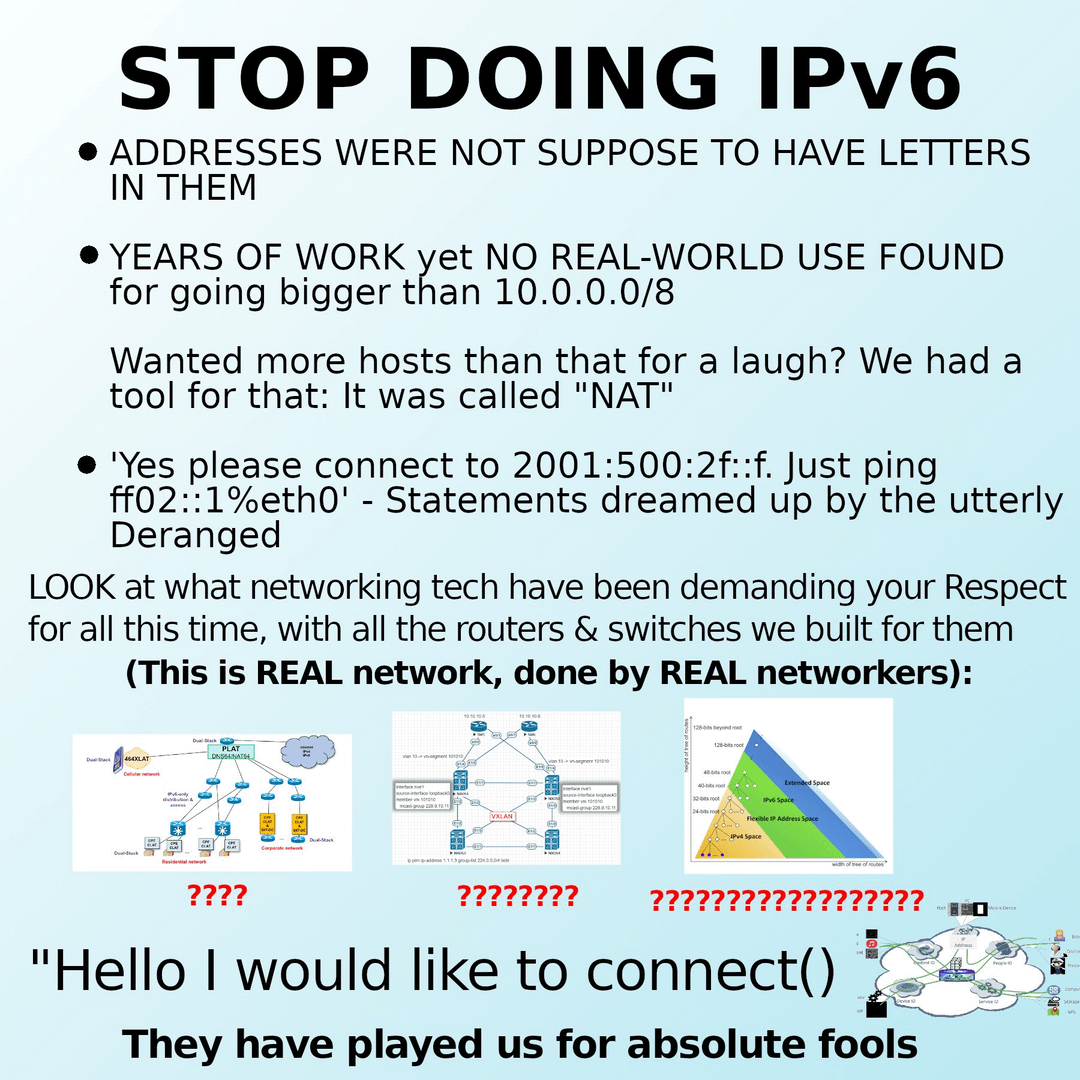
stop-doing-ipv6.pngpistolero likes this. -
Embed this notice
Haelwenn /элвэн/ :triskell: (lanodan@queer.hacktivis.me)'s status on Sunday, 19-Oct-2025 21:07:26 JST  Haelwenn /элвэн/ :triskell:
@p @phnt @slashb Meanwhile I tend to do that but with IPv4, too much spam there so some of my stuff (SSH, NFS) is IPv6-only. :D pistolero likes this. -
Embed this notice
🌈ᚩ🌈 (bonifartius@noauthority.social)'s status on Monday, 20-Oct-2025 02:31:42 JST  🌈ᚩ🌈
pistolero repeated this.
🌈ᚩ🌈
pistolero repeated this. -
Embed this notice
Phantasm (phnt@fluffytail.org)'s status on Monday, 20-Oct-2025 02:31:42 JST
Phantasm
@bonifartius @p @slashb Alright, I'm taking the bait: https://fluffytail.org/notice/Aw5gVMaOdjN6UhNR9k pistolero likes this. -
Embed this notice
Protoss (latein@cawfee.club)'s status on Monday, 20-Oct-2025 02:33:16 JST  Protoss
@phnt @p @slashb f is a number, not a letter, troglodyte pistolero likes this. -
Embed this notice
pistolero (p@fsebugoutzone.org)'s status on Monday, 20-Oct-2025 02:37:44 JST
pistolero
@latein @phnt @slashb "f" is a droring. -
Embed this notice
pistolero (p@fsebugoutzone.org)'s status on Monday, 20-Oct-2025 02:38:54 JST
pistolero
@lanodan @phnt @slashb It's easy to restrict access when you don't want something to be public, but that's clever. Some stuff that I want accessible but not necessarily public, that stuff's on Tor now. -
Embed this notice
𝕾𝖎𝖗 𝕽𝖞𝖆𝖓 𝕿𝖍𝖔𝖒𝖆𝖘 (ryan@bxe.io)'s status on Monday, 20-Oct-2025 02:39:34 JST  𝕾𝖎𝖗 𝕽𝖞𝖆𝖓 𝕿𝖍𝖔𝖒𝖆𝖘
@bonifartius @phnt @p @slashb real ipv6 has never been tried Haelwenn /элвэн/ :triskell: and pistolero like this.pistolero repeated this. -
Embed this notice
Haelwenn /элвэн/ :triskell: (lanodan@queer.hacktivis.me)'s status on Monday, 20-Oct-2025 02:52:52 JST
Haelwenn /элвэн/ :triskell:
@p @phnt @slashb Yeah, I've sometimes put some stuff on Tor as well, specially SSH.
But IIRC it's a bit of a mess to put stuff behind a separate .onion in the case where you already have a public onion service (and tor network also has a lot of bots, specially these days).pistolero likes this. -
Embed this notice
Haelwenn /элвэн/ :triskell: (lanodan@queer.hacktivis.me)'s status on Monday, 20-Oct-2025 02:55:45 JST
Haelwenn /элвэн/ :triskell:
@ryan @phnt @p @slashb @bonifartius ISP but good has never been tried. pistolero likes this.pistolero repeated this. -
Embed this notice
pistolero (p@fsebugoutzone.org)'s status on Monday, 20-Oct-2025 02:56:07 JST
pistolero
@bonifartius @phnt @slashb
> why? not being routed is what firewalls are made for. not being routable by default is a side effect of NAT, not a feature.
This is the first place everyone goes.
The explicit goal of the utopian lunatics that created IPng, which became IPv6, was to ensure that your coffee pot *did* have a publicly routeable address. It was explicit. It was in the docs. These ideas predated even the wide adoption of IPv4--when the presumption was that malicious traffic would be rare and no one knew exactly how many things would be fucked up by heap allocations, a time before the Code Red worm--and the ideas have not been updated since, despite all of the practical experience gained going from "no global network" to "global network". If an event occurs that is unprecedented in the history of the earth and the experience does not update your ideas, then your ideas are divorced from reality.
You look at "Network 10 Considered Harmful" and they're wringing their hands that if private subnets proliferate, we won't run out of addresses fast enough and then people won't be forced into IPng where your coffee pot will be publicly routeable. These people have been trying to create the catastrophe for 30 years so that you will use their terrible Second System. This is why, until everyone stopped listening, they kept publishing these "Well now we're *really* out of IPv4 addresses" press releases every four years or so. That's not to say that we've got plenty of IPv4 addresses or that IPv4 is the ideal solution, but if there's a guy that expects an inheritance and he keeps trying to pull the plug on your life support, maybe that guy's not the right guy to trust.
Nobody likes NAT. That doesn't mean that NAT is the worst thing that can happen to you. (The worst thing that can happen to you is IPv6.)
ipv6_cve--i_am_never_wrong_about_anything.gif✙ dcc :pedomustdie: :phear_slackware: likes this. -
Embed this notice
🌈ᚩ🌈 (bonifartius@noauthority.social)'s status on Monday, 20-Oct-2025 02:56:08 JST
🌈ᚩ🌈
@phnt @p @slashb
> The idea that devices on my LAN should get publicly routable addresses is insane.why? not being routed is what firewalls are made for. not being routable by default is a side effect of NAT, not a feature. link local isn't routeable anyway, if you don't have a router set up to announce the route for slaac or dhcpv6 your devices don't get routeable addresses.
-
Embed this notice
Phantasm (phnt@fluffytail.org)'s status on Monday, 20-Oct-2025 03:06:43 JST
Phantasm
@lanodan @ryan @p @slashb @bonifartius What is an ISP but a miserable pile of black boxes. pistolero likes this. -
Embed this notice
Haelwenn /элвэн/ :triskell: (lanodan@queer.hacktivis.me)'s status on Monday, 20-Oct-2025 03:06:43 JST
Haelwenn /элвэн/ :triskell:
@phnt @ryan @p @slashb @bonifartius ISPs are more like this but spread over the country.
wireeeeessssss.jpgpistolero likes this. -
Embed this notice
pistolero (p@fsebugoutzone.org)'s status on Monday, 20-Oct-2025 03:07:50 JST
pistolero
@bonifartius @phnt @slashb
> i don't really see what's the use of a connected networked device but without the right settings to actually work?
"Working" is not reasonably defined as "publicly routeable" because "I want to be able to communicate between these two systems" is a very different proposition from "I want this system exposed to the public".
When the next Mirai-level botnet occurs, all of the people that said "Pfff, NAT isn't a security feature, you should configure your router properly" are still going to blame the routers. ISPs hate for you to run your own router anyway, they try to avoid letting you do that kind fo thing, so "configure your router" means "hack this shitty cheap thing that Comcast misconfigured". And the internet will be nuked and shat on and they'll still be insisting that there's no reason to ever be cautious about a transition between two fundamentally different states.
And, you know, I shouldn't take the bait. I should just post the links to https://tailscale.com/blog/two-internets-both-flakey/ and https://apenwarr.ca/log/20170810 and be done with it.
network_security_architecture--backdoors.jpg✙ dcc :pedomustdie: :phear_slackware: likes this. -
Embed this notice
🌈ᚩ🌈 (bonifartius@noauthority.social)'s status on Monday, 20-Oct-2025 03:07:51 JST
🌈ᚩ🌈
@phnt @p @slashb
> SLAAC and link-local gateways is insane.there is an v4 version of this when there is no dhcp around, 169.* subnet or something. link local addresses aren't routed. if one doesn't want the slaac routers, don't have the router advertise itself as a router - i don't really see what's the use of a connected networked device but without the right settings to actually work?
-
Embed this notice
🌈ᚩ🌈 (bonifartius@noauthority.social)'s status on Monday, 20-Oct-2025 03:08:49 JST
🌈ᚩ🌈
pistolero likes this. -
Embed this notice
🌈ᚩ🌈 (bonifartius@noauthority.social)'s status on Monday, 20-Oct-2025 03:08:53 JST
🌈ᚩ🌈
@phnt @p @slashb everything's just like my opinion, of course. ipv6 isn't perfect, but pretty well designed. one has to know much fewer special cases, almost everything you need to know is encoded in the address itself. most of the problems seem to be either chinesium routers doing v6 like you'd do v4 or isps being isps.
maybe v6 just is too nice in it's assumptions and out of place in this world ;)
pistolero likes this.pistolero repeated this. -
Embed this notice
🌈ᚩ🌈 (bonifartius@noauthority.social)'s status on Monday, 20-Oct-2025 03:08:54 JST
🌈ᚩ🌈
@phnt @p @slashb
> > When hosting providers throw /64s at every VM you buy, the size of the address space is useless when it's occupied by a small fraction of machines. IPs are supposed to be addresses to machines and not that you have 2^64 addresses resemble a single machine.the last 64 bit are the interface address. the first 64 bits for the network already are 32 bit more than the whole address space of v4. i'd have used longer prefixes, but in reality it's not that relevant imo.
-
Embed this notice
pistolero (p@fsebugoutzone.org)'s status on Monday, 20-Oct-2025 03:09:22 JST
pistolero
@bonifartius @phnt @slashb
> maybe v6 just is too nice in it's assumptions and out of place in this world ;)
It is, yes. -
Embed this notice
Phantasm (phnt@fluffytail.org)'s status on Monday, 20-Oct-2025 03:09:29 JST
Phantasm
@bonifartius @p @slashb Taking the bait part 2:
>why? not being routed is what firewalls are made for.
That assumes that everything that runs on IPv6 at home has properly functional firewalls. Spoiler alert: It doesn't and never will. Especially when the router acts only as a gateway without proper firewall which is almost always because UPnP exists and somehow is always enabled by default
>not being routable by default is a side effect of NAT, not a feature.
No this is a feature. LAN as the name says is _local_. The idea that a machine on my _local_ network gets a routable address everywhere by default as envisioned when the protocol was made is insane and there's no questioning about that. Especially if it is done automatically like now.
>if you don't have a router set up to announce the route for slaac or dhcpv6 your devices don't get routable addresses.
How this works is that ISP announces your assigned range and that's it. The fact that the specific address isn't announced like "Hey, I exist" changes almost nothing. It will still get routed to your home by the ISP. You can also knock in the ranges rather easily, or just look at DHT from BitTorrent and now you have an actual address. This knocking is already a common thing in botnet router exploitation.
>there is an v4 version of this when there is no dhcp around, 169.* subnet or something.
Yes, and only Windows uses that. It's called APIPA.
>link local addresses aren't routed.
They are locally and nothing asks you if you want that.
>i don't really see what's the use of a connected networked device but without the right settings to actually work?
To-be-assigned static addresses, general testing, temporarily putting the machine out of the network for whatever reason and more.
>the last 64 bit are the interface address. the first 64 bits for the network already are 32 bit more than the whole address space of v4. i'd have used longer prefixes, but in reality it's not that relevant imo.
The whole point of IPv6 was that we would hopefully never run out of addresses, then ff a decade and we are throwing /64 subnets that describe _one_ machine on the Internet. Does that make sense? The point of v6 was also that we would make P2P networking actually usable with the routable addresses on your local network, which is a good idea on paper, but terribly executed. It never should have been automatic.pistolero likes this. -
Embed this notice
pistolero (p@fsebugoutzone.org)'s status on Monday, 20-Oct-2025 03:23:50 JST
pistolero
@phnt @bonifartius @slashb
> which is almost always because UPnP exists and somehow is always enabled by default
UPnP isn't even the worst of it. I arrived here and the router here had port 80 open to the world and "admin"/"admin" as the credentials. The ISP set this terrible goddamn router up: they're also the *only* ISP that serves this area.
> No this is a feature.
Well, a feature of the existence of private address spaces, right; NAT was developed to map private IP spaces onto public ones, and then they built the cone and this, because it took address allocations away from the Central Committee and just gave you a class-A to do whatever with, was anathema to the Central Committee.
> This knocking is already a common thing in botnet router exploitation.
This is imporant shit that will end up completely ignored by everyone that is engaged in motivated reasoning around IPv6.
> Yes, and only Windows uses that. It's called APIPA.
dhcpcd will try to give you one if you don't get a DHCP response and you don't give it -L. -
Embed this notice
Phantasm (phnt@fluffytail.org)'s status on Monday, 20-Oct-2025 03:24:00 JST
Phantasm
@bonifartius @p @slashb
>>i don't really see what's the use of a connected networked device but without the right settings to actually work?
>To-be-assigned static addresses, general testing, temporarily putting the machine out of the network for whatever reason and more.
Also the idea that a computer does something automatically that I never asked for is stupid. A computer does what I tell it to do, nothing more and not less.
pic unrelated
toiler-computer.jpgpistolero likes this. -
Embed this notice
pistolero (p@fsebugoutzone.org)'s status on Monday, 20-Oct-2025 03:25:26 JST
pistolero
@phnt @bonifartius @slashb
> pic unrelated
Not any more!
computertoilet.jpg✙ dcc :pedomustdie: :phear_slackware: likes this. -
Embed this notice
Haelwenn /элвэн/ :triskell: (lanodan@queer.hacktivis.me)'s status on Monday, 20-Oct-2025 03:31:40 JST
Haelwenn /элвэн/ :triskell:
@p @phnt @slashb @bonifartius NAT is just packet mangling though, so if wan side of things comes in with a spoofed address matching your local subnet, they have access to your LAN, unless you do in fact have a firewall (pretty much everyone's box is setup that way except maybe the bullshit like exposed OpenWRT boxes, see /luci/ on shodan.io).
pistolero likes this. -
Embed this notice
🌈ᚩ🌈 (bonifartius@noauthority.social)'s status on Monday, 20-Oct-2025 03:41:08 JST
🌈ᚩ🌈
@phnt @p @slashb
> because UPnP existsthat's a problem with v4 as well. upnp will set up forwarding rules.
> gets a routable address everywhere by default
turn off slaac on the client, turn off router announcements, etc.
> ISP announces your assigned range
to your router. if your router then announces this route, slaac will use it. turn off the announcements.
-
Embed this notice
pistolero (p@fsebugoutzone.org)'s status on Monday, 20-Oct-2025 03:41:08 JST
pistolero
@bonifartius @phnt @slashb
> turn off slaac on the client, turn off router announcements, etc.
I fully expect competent network management practices from all people that bought a light bulb with an app on it and have a refrigerator that shows them ads. I mean, sure, they may have ended up unwitting participants in the Mirai botnet that was built by literal teenagers the first time around, but they may have bought the "smart" devices because they thought it was cool, but I'm sure that since then they learned how computers work.
The majority of the networks on this earth have no administrator. They have a half-assed router set up by the ISP and that thing's defaults, set in a factory in Shenzhen and decided by an engineer that was working on the 996 schedule and whose boss didn't understand GPL compliance and then, because they were the shittiest manufacturer they were also the cheapest, and then because they were the cheapest, that's who the ISP bought the gear from. Everyone was running open wifi until the defaults on the routers started including WEP, then everyone was running WEP until WPA became the default. These are networks whose administration is done by nobody. The ISP blames the manufacturer and has no accountability, the boomer uses the thing that came in the box and has no accountability, the manufacturer says the ISP was stupid for using the defaults and has no accountability, and there is a problem that no one is responsible for solving until the Mirai botnet happens.
So, "do a thing" is not a solution. Do you really want to give a publicly routeable address to every dang Android feature phone, every light bulb, every Windows machine, every coffee pot, and then go "Well, they should have configured it properly"?Haelwenn /элвэн/ :triskell: likes this. -
Embed this notice
pistolero (p@fsebugoutzone.org)'s status on Monday, 20-Oct-2025 03:44:06 JST
pistolero
@bonifartius @phnt @slashb
> net.ipv6.conf.all.autoconf = 0
net.ipv6.conf.all.disable_ipv6 = 1
> i'd argue that for a network this is the special case.
So's running your own OS, and this is why manufacturers want to lock down the bootloader at the factory. Apple got away with it, Microsoft hasn't managed yet, but forget the goddamn phone market.
If you fuck up the people that make weird things, you fuck up the people that want to use those weird things, and eventually you fuck up everything for everyone.
> if i'd have designed it, i probably had made the network prefix longer.
We don't need more than 64 bits of address space but we got 128 and it's a colossal fuckup. We should have stuck with 48, 64. 64 would have been fine *forever*. -
Embed this notice
🌈ᚩ🌈 (bonifartius@noauthority.social)'s status on Monday, 20-Oct-2025 03:44:07 JST
🌈ᚩ🌈
> They are locally and nothing asks you if you want that.
net.ipv6.conf.all.accept_ra = 0
net.ipv6.conf.all.autoconf = 0> To-be-assigned static addresses, general testing
i'd argue that for a network this is the special case.
> we would hopefully never run out of addresses
with 32 bit we have about 4294967296 addresses, with 64 bits there are 18446744073709551616 networks. if i'd have designed it, i probably had made the network prefix longer.
-
Embed this notice
wuhan.bat™ (jae@darkdork.dev)'s status on Monday, 20-Oct-2025 03:51:51 JST  wuhan.bat™
@ryan @phnt @p @slashb @bonifartius literally best post of the day. pistolero likes this. -
Embed this notice
ins0mniak (ins0mniak@mikoshidata.cloud)'s status on Monday, 20-Oct-2025 03:53:53 JST  ins0mniak
@p @phnt @slashb @lanodan
https://bafybeicye6nirj6tvswoluatdprahl6dhjj74qjsvcb3pzpej6bgqi4gvm.ipfs.dweb.link?filename=01%20The%20Ballad%20of%20Buck%20Ravers.m4apistolero likes this. -
Embed this notice
pistolero (p@fsebugoutzone.org)'s status on Monday, 20-Oct-2025 03:55:34 JST
pistolero
@lanodan @phnt @slashb The way you get your addresses is kind of annoying but other than that, I don't have any trouble running a bunch of Tor services. I set up a hidden service for ssh but I've not actually attempted to use it. -
Embed this notice
pistolero (p@fsebugoutzone.org)'s status on Monday, 20-Oct-2025 03:56:59 JST
pistolero
@ins0mniak @lanodan @phnt @slashb https://media.freespeechextremist.com/rvl/full/6922ecadab27efa55edabbee72b5190e787a9115e5d8b149a991131cac95646b?name=fedibbs.tgz -
Embed this notice
Phantasm (phnt@fluffytail.org)'s status on Monday, 20-Oct-2025 03:57:04 JST
Phantasm
@bonifartius @p @slashb
>net.ipv6.conf.all.accept_ra = 0
>net.ipv6.conf.all.autoconf = 0
Again, I didn't ask for this. I didn't check a checkbox, or added an option to *insert network manager* that tells it to "please, auto configure this interface".
It's automatic and without my input. People twentyfive years ago would call that malware.pistolero likes this. -
Embed this notice
pistolero (p@fsebugoutzone.org)'s status on Monday, 20-Oct-2025 03:58:15 JST
pistolero
@lanodan @phnt @bonifartius @ryan @slashb
ethernet_throne.jpgDoughnut Lollipop 【記録係】:blobfoxgooglymlem: likes this. -
Embed this notice
Suzu (suzu@detroitriotcity.com)'s status on Monday, 20-Oct-2025 03:59:12 JST  Suzu
Suzu
@p @phnt @slashb @bonifartius
Hey p, speaking of "the internet ending", what's your opinion on projects like Meshtastic and Meshcore?pistolero likes this. -
Embed this notice
Haelwenn /элвэн/ :triskell: (lanodan@queer.hacktivis.me)'s status on Monday, 20-Oct-2025 04:00:32 JST
Haelwenn /элвэн/ :triskell:
@p @phnt @slashb @bonifartius Well what's the difference between SLAAC and DHCP though? At least from the perspective of a lightbulb where that stuff is always going to be enabled anyway.
It'll get networking, the kind of IP or physical protocol doesn't matters. It'll be part of a botnet (auto-updates, configuration through "cloud", …) at manufacturing time, and then turns out the domain used for the botnet was bought by someone else, or manufacturer got pwned.
Also I'd say current botnet is stuff like web browsers https://en.wikipedia.org/wiki/Hola_(VPN) and Android SDKs https://jan.wildeboer.net/2025/04/Web-is-Broken-Botnet-Part-2/ as after all HTTP is the TCP of 2025.
pistolero likes this. -
Embed this notice
pistolero (p@fsebugoutzone.org)'s status on Monday, 20-Oct-2025 04:02:34 JST
pistolero
@Suzu @bonifartius @phnt @slashb Consider my recent interest in PPP-over-RF and you should probably be able to extrapolate. -
Embed this notice
pistolero (p@fsebugoutzone.org)'s status on Monday, 20-Oct-2025 04:03:31 JST
pistolero
@lanodan @bonifartius @phnt @slashb
> so if wan side of things comes in with a spoofed address matching your local subnet
Yeah, there's some P2P software that actually relies on this; it's non-trivial to do, though. -
Embed this notice
Phantasm (phnt@fluffytail.org)'s status on Monday, 20-Oct-2025 04:10:43 JST
Phantasm
@p @slashb @bonifartius Whenever I get my hands on a cheap Chinese network appliance, my favorite thing to do is dump the firmware. There's a 90% chance that you will find one or more of the following: hard-coded creds, hard-coded ssh public key with ssh started, unencrypted http traffic for system components. Security in IoT is basically non-existent in anything outside of "big" brands. And even those aren't immune to the usual vulnerabilities in the hosted UI accessible with default creds proudly hosted by the manufacturer on their website. Haelwenn /элвэн/ :triskell: and pistolero like this.pistolero repeated this. -
Embed this notice
ins0mniak (ins0mniak@mikoshidata.cloud)'s status on Monday, 20-Oct-2025 04:10:55 JST
ins0mniak
@phnt @p @slashb @bonifartius :AAAAAA_glitch: pistolero likes this. -
Embed this notice
Phantasm (phnt@fluffytail.org)'s status on Monday, 20-Oct-2025 04:10:56 JST
Phantasm
@p @slashb @bonifartius
>ISP box
I would call than an improvement over mine. I need an app on my phone that generates TOTP-like codes to have access to such "advanced" settings like disabling WiFi frequencies, changing SSID and setting channels. Port forwarding in an option there, but it does not work and the moment I log off, it gets wiped anyway.
>dhcpd
That is at least excusable because you wanted to auto configure by running that. Not ideal, but at least there's an excuse. -
Embed this notice
pistolero (p@fsebugoutzone.org)'s status on Monday, 20-Oct-2025 04:10:56 JST
pistolero
@phnt @bonifartius @slashb
> I would call than an improvement over mine.
"How do I get into this fuckin' router" was a problem I was able to solve very quickly, so that was at least convenient: if *anyone* can get in, that made it pretty easy for me to get in (and close down remote management).
> I need an app on my phone that generates TOTP-like codes to have access to such "advanced" settings like disabling WiFi frequencies, changing SSID and setting channels.
Oh, goddamn.
I got to do my favorite shit ever--lying to tech support about unplugging things--when I replaced my cable modem at my old place. Cable modems use MAC for "authentication" so you have to call the cable company and give them your new MAC address, right, but the tech support monkey didn't know this and thus had to run through the entire tech support script while I said things like "My google still doesn't work!" and then finally I heard the magic words: "There should be a number that says 'MAC address' on the back of your modem."
> That is at least excusable because you wanted to auto configure by running that. Not ideal, but at least there's an excuse.
Irritates the shit out of me because it's enabled by default.
13._hacker.mp3Haelwenn /элвэн/ :triskell: likes this. -
Embed this notice
pistolero (p@fsebugoutzone.org)'s status on Monday, 20-Oct-2025 04:11:48 JST
pistolero
@phnt @bonifartius @slashb :cereal:
ytcracker--i_invented_the_computer--03_dirty_code.mp3 -
Embed this notice
mr64bit (mr64bit@p.mr64.net)'s status on Monday, 20-Oct-2025 04:11:57 JST  mr64bit
@phnt @p @slashb @bonifartius the S in IoT stands for security, after all. Haelwenn /элвэн/ :triskell: and pistolero like this. -
Embed this notice
Phantasm (phnt@fluffytail.org)'s status on Monday, 20-Oct-2025 04:12:44 JST
Phantasm
@p @bonifartius @slashb of course app needs an account to work. Forgot to mention that since that is now the standard apparently. Haelwenn /элвэн/ :triskell: and pistolero like this. -
Embed this notice
pistolero (p@fsebugoutzone.org)'s status on Monday, 20-Oct-2025 04:12:44 JST
pistolero
@phnt @bonifartius @slashb Please take a photo of your government ID. -
Embed this notice
ins0mniak (ins0mniak@mikoshidata.cloud)'s status on Monday, 20-Oct-2025 04:15:07 JST
ins0mniak
@p @phnt @slashb @lanodan :acat: pistolero likes this. -
Embed this notice
pistolero (p@fsebugoutzone.org)'s status on Monday, 20-Oct-2025 04:21:20 JST
pistolero
@lanodan @bonifartius @phnt @slashb
> Well what's the difference between SLAAC and DHCP though? At least from the perspective of a lightbulb where that stuff is always going to be enabled anyway.
The lightbulb's perspective doesn't matter; the network administrator's does, though.
> Also I'd say current botnet is stuff like web browsers https://en.wikipedia.org/wiki/Hola_(VPN) and Android SDKs https://jan.wildeboer.net/2025/04/Web-is-Broken-Botnet-Part-2/ as after all HTTP is the TCP of 2025.
https://scrapeops.io/web-scraping-playbook/residential-mobile-proxies-economics/
bright-sdk.com
infatica-sdk.ioHaelwenn /элвэн/ :triskell: likes this. -
Embed this notice
Haelwenn /элвэн/ :triskell: (lanodan@queer.hacktivis.me)'s status on Monday, 20-Oct-2025 04:23:13 JST
Haelwenn /элвэн/ :triskell:
@phnt @p @slashb @bonifartius At least one that's "fun" with those when you have a decent email service is to give them a unique email address (like catch-all or using a + or . as separator like user.service@) that way you know exactly when their bullshit got owned and you get a address as honeypot/spamtrap.
Saddest of all… ISP I use got their customer database leaked, so I had to rotate the email address I gave them.
pistolero likes this. -
Embed this notice
cjd (cjd@pkteerium.xyz)'s status on Monday, 20-Oct-2025 04:23:16 JST  cjd
cjd
IPv6 is a psyop, at the core it's actually just an overlay network but the WEF furry network engineers make everyone swear to secrecy so that edge network engineers (also called edgelords) will waste all of their time trying to configure it instead of realizing the NSA is inside all of their routers. pistolero likes this. -
Embed this notice
SilverDeth (silverdeth@fsebugoutzone.org)'s status on Monday, 20-Oct-2025 04:41:16 JST
SilverDeth
@p @lanodan @bonifartius @phnt @ryan @slashb
Ahh Yes.... Ragnær Terrydavisón god of IPX.pistolero likes this. -
Embed this notice
pistolero (p@fsebugoutzone.org)'s status on Monday, 20-Oct-2025 04:46:56 JST
pistolero
@lanodan @phnt @bonifartius @slashb
> Saddest of all… ISP I use got their customer database leaked, so I had to rotate the email address I gave them.
I had spam@ for a while and then a lot of them started disallowing that and also disallowing email addresses that contain their company name so I have a lot of rot13 aliases because they're not clever enough to understand 'fcnz@' and I ended up having to remove that alias pretty quickly. -
Embed this notice
pistolero (p@fsebugoutzone.org)'s status on Monday, 20-Oct-2025 04:47:02 JST
pistolero
@cjd @ryan @bonifartius @phnt @slashb :terrylol2: -
Embed this notice
Diogenese_Shiplap (diogenese_shiplap@poa.st)'s status on Monday, 20-Oct-2025 04:47:36 JST  Diogenese_Shiplap
@lanodan @p @phnt @slashb @bonifartius Y'all leave muh DOHC engines alone! The sacred Double OverHead Cam is part of muh religion! AAAAAAAAA! pistolero likes this. -
Embed this notice
Haelwenn /элвэн/ :triskell: (lanodan@queer.hacktivis.me)'s status on Monday, 20-Oct-2025 04:52:08 JST
Haelwenn /элвэн/ :triskell:
@p @phnt @slashb @bonifartius Interestingly I haven't got issues with using the company name, which is funny because of course some secretaries end up reading it as if it was flipped around so lanodan@company.com
Makes me really feel like phishing has got to be the easiest shit to pull off.pistolero likes this. -
Embed this notice
pistolero (p@fsebugoutzone.org)'s status on Monday, 20-Oct-2025 04:58:44 JST
pistolero
@lanodan @bonifartius @phnt @slashb
> Makes me really feel like phishing has got to be the easiest shit to pull off.
Two separate companies, I received Slack messages from people I'd never heard of giving me links to cryptpads that were set up on non-company-related domains and it was legit both times but also both times I pinged the team channel and got not response.
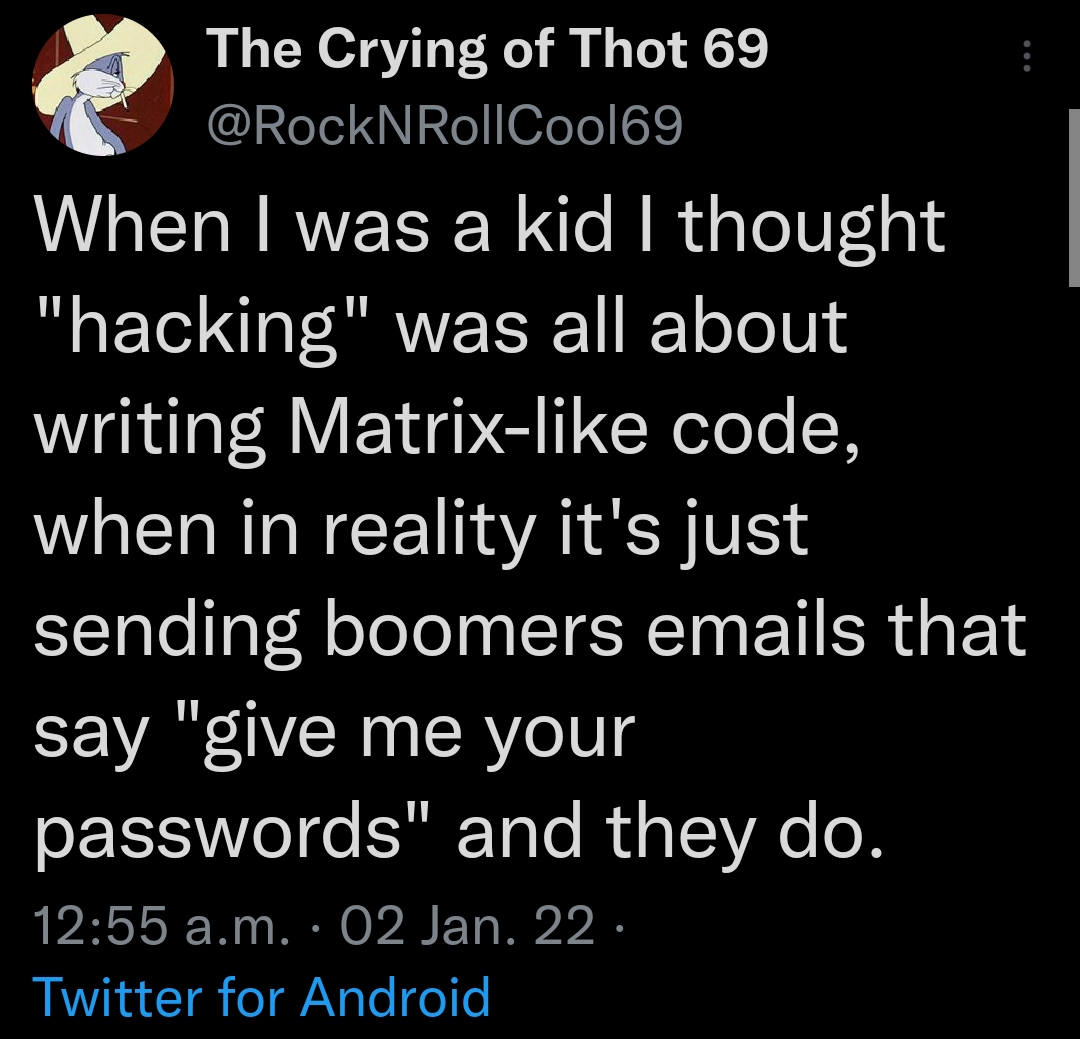
hacking_boomers.pngHaelwenn /элвэн/ :triskell: and Blurry Moon like this. -
Embed this notice
🌈ᚩ🌈 (bonifartius@noauthority.social)'s status on Monday, 20-Oct-2025 05:41:06 JST
🌈ᚩ🌈
@p @Suzu @phnt @slashb i did test a ppp link over lora a while back and it worked. pings were 1s though ;)
pistolero likes this. -
Embed this notice
pistolero (p@fsebugoutzone.org)'s status on Monday, 20-Oct-2025 05:41:29 JST
pistolero
@bonifartius @Suzu @phnt @slashb
> i did test a ppp link over lora a while back and it worked. pings were 1s though ;)
This is fine from my perspective. -
Embed this notice
🌈ᚩ🌈 (bonifartius@noauthority.social)'s status on Monday, 20-Oct-2025 06:10:20 JST
🌈ᚩ🌈
@p @Suzu @phnt @slashb i didn't fiddle round with it for long. maybe by tuning some lora parameters things can be optimized. i think part of the latency is the half duplex operation (not sure on this).
pistolero likes this. -
Embed this notice
pistolero (p@fsebugoutzone.org)'s status on Monday, 20-Oct-2025 06:15:01 JST
pistolero
@bonifartius @Suzu @phnt @slashb I get the tendency to wanna fix stuff like that, but I think trickles over strange channels are interesting. -
Embed this notice
🌈ᚩ🌈 (bonifartius@noauthority.social)'s status on Monday, 20-Oct-2025 06:15:08 JST
🌈ᚩ🌈
@p @Suzu @phnt @slashb my "vision" for these things would be some store n forward thing like usenet was. don't really have anyone round here to try these things though. round here the only lora in use seems to be this iot-internet gateway stuff i can't remember the name of.
pistolero likes this. -
Embed this notice
pistolero (p@fsebugoutzone.org)'s status on Monday, 20-Oct-2025 06:16:00 JST
pistolero
@bonifartius @Suzu @phnt @slashb You ever look at js8call? -
Embed this notice
radix023 (radix023@noauthority.social)'s status on Monday, 20-Oct-2025 06:19:53 JST  radix023
@bonifartius @p @Suzu @phnt @slashb
you iknow some groundwork has been done in this direction already:
pistolero likes this. -
Embed this notice
🌈ᚩ🌈 (bonifartius@noauthority.social)'s status on Monday, 20-Oct-2025 07:00:28 JST
🌈ᚩ🌈
@p @Suzu @phnt @slashb never heard of it! looks interesting, although the ham-requirement likely will keep me away from it. don't want (or have the time) to jump through the hoops of getting loicensed or getting fined amounts of money i don't have.
pistolero likes this. -
Embed this notice
pistolero (p@fsebugoutzone.org)'s status on Monday, 20-Oct-2025 07:00:43 JST
pistolero
@bonifartius @Suzu @phnt @slashb
> although the ham-requirement likely will keep me away from it.
Super low-power, you can run the thing with a board antenna. Ham requirements only matter if you intend to make enough noise that they come looking for you, and even then, like, the FCC took 15 years to shut down the pirate FM station that was broadcasting Alex Jones in Austin. But if you're *actually* worried, transmissions on several bands are fine unlicensed, and if you keep it under 1W, you can transmit whatever to wherever. (Before you write off 1W, some :aussie: did a moon bounce using only 50W. It's just solving physics problems and doing some practical engineering like noise floor for frequencies you wanna use. It's fun shit.) There's always the option of using unlicensed bands: they tend to be noisy anyway, bottom of the food chain (below military, commercial, NOAA, and even the hams), but you can do it. -
Embed this notice
🌈ᚩ🌈 (bonifartius@noauthority.social)'s status on Monday, 20-Oct-2025 07:00:51 JST
🌈ᚩ🌈
@radix023 @p @Suzu @phnt @slashb didn't know of this as well :)
i think the most basic question is if one wants a broadcast-mesh-something system (it's broadcasted anyway) or "calling up" a host at 2am to transmit this days data. i'm not sure which one is better?
pistolero likes this. -
Embed this notice
Phantasm (phnt@fluffytail.org)'s status on Monday, 20-Oct-2025 07:01:20 JST
Phantasm
@p @slashb @bonifartius My ISP does some stupid probably PK auth, because nothing works until their shitty router sends a magic packet after getting time from NTP. That packet is always different. I borrowed fiber stuff from work so that I could use my equipment, but no. Bridge mode of course doesn't exist.
Of course I didn't even want fiber as 100Mb/s doesn't need that and copper worked fine. But my small local ISP got bought by one of the 3 big ones here and forced it down on me. It irritates me to this day. And as a bonus, the new ISP's peering got worse and now my connection to the outside world is almost exclusively Cogent. I was enjoying lovely speeds of 120KB/s to fluffytail.org for 3 weeks until Cogent got their shit together again. And this happens like every other month.Haelwenn /элвэн/ :triskell: and pistolero like this. -
Embed this notice
pistolero (p@fsebugoutzone.org)'s status on Monday, 20-Oct-2025 07:10:31 JST
pistolero
@phnt @bonifartius @slashb
> My ISP does some stupid probably PK auth, because nothing works until their shitty router sends a magic packet after getting time from NTP. That packet is always different. I borrowed fiber stuff from work so that I could use my equipment, but no.
Seems like they should allow you. Like, do they have a "No, we own both sides of the pipe" in their ToS, or just haven't tried to deal with them directly yet?
> now my connection to the outside world is almost exclusively Cogent.
That's almost as bad as being IPv6-only.Haelwenn /элвэн/ :triskell: likes this. -
Embed this notice
Phantasm (phnt@fluffytail.org)'s status on Monday, 20-Oct-2025 07:10:55 JST
Phantasm
@p @Suzu @slashb @bonifartius With 20W and a good antenna you can cover whole of Europe on HF. pistolero likes this.pistolero repeated this. -
Embed this notice
Phantasm (phnt@fluffytail.org)'s status on Monday, 20-Oct-2025 07:11:43 JST
Phantasm
@p @Suzu @bonifartius @slashb And you can reach ISS's digipeater on 5 or 10. pistolero likes this. -
Embed this notice
sicp (sicp@freebeerextremist.com)'s status on Monday, 20-Oct-2025 07:17:49 JST  sicp
sicp
@bonifartius @p @Suzu @phnt @slashb I think UUCP over RF links could work, you could run it over AX.25. pistolero likes this. -
Embed this notice
Nietzschean Ekko Enjoyer (r000t@ligma.pro)'s status on Monday, 20-Oct-2025 07:43:20 JST  Nietzschean Ekko Enjoyer
@p
The PDU scepter is what makes it
@ryan @phnt @slashb @bonifartius @lanodanpistolero likes this. -
Embed this notice
pistolero (p@fsebugoutzone.org)'s status on Monday, 20-Oct-2025 07:45:19 JST
pistolero
@phnt @bonifartius @slashb
> everyone I've talked to from them so far was either a smug idiot and/or annoying sales guy.
I had this experience with AT&T (which is just the SBC/PacBell merger; they bought the AT&T name for a song once AT&T had divested itself of enough divisions to be small enough to acquire): very explicit on the phone, asked the guy several times. I receive the gear, start using it, reboot the modem to confirm, and the IP address changes. Time Warner Business had a reasonable guy, I talked to him and asked, "You understand why I wouldn't want the IP for ns1 to change, right?" and he laughed. Their residential service was not great but the business line was excellent until they merged with Charter and formed Spectrum; I don't recommend Spectrum Business.
> And not something small, the whole republic had no connectivity on their network the last four times this happened in the last 10 months.
Goddamn.✙ dcc :pedomustdie: :phear_slackware: likes this. -
Embed this notice
Phantasm (phnt@fluffytail.org)'s status on Monday, 20-Oct-2025 07:45:20 JST
Phantasm
@p @slashb @bonifartius I haven't tried talking about it with them, but everyone I've talked to from them so far was either a smug idiot and/or annoying sales guy. I did not attempt to dump the FW either as their "price" for the router is and I kid you not 300USD converted.
That said, I'll be moving to someone else in the near future anyway. I'm tired of their outages every few months for a day. And not something small, the whole republic had no connectivity on their network the last four times this happened in the last 10 months. It's insane.Haelwenn /элвэн/ :triskell: and pistolero like this. -
Embed this notice
Phantasm (phnt@fluffytail.org)'s status on Monday, 20-Oct-2025 07:45:30 JST
Phantasm
@sicp @Suzu @p @slashb @bonifartius 44net still exists I think which uses plain TCP/IP. pistolero likes this. -
Embed this notice
🌈ᚩ🌈 (bonifartius@noauthority.social)'s status on Monday, 20-Oct-2025 07:46:08 JST
🌈ᚩ🌈
@p @Suzu @phnt @slashb well i _have_ this shady chinese handheld radio around :)
the default js8call frequencies seem to be in some ham frequency band which requires a loicense. i'm worried because i think the fines are in the 10k€ range and ham operators don't seem to "appreciate" people who aren't part of their club. hence i tried out lora which is in the unlicensed band.
pistolero likes this. -
Embed this notice
sicp (sicp@freebeerextremist.com)'s status on Monday, 20-Oct-2025 07:47:37 JST
sicp
@phnt @Suzu @p @slashb @bonifartius Yeah it does, the overhead of TCP/IP from what I've read makes it really slow though, like, over a 1200 baud link it's not that usable, so most of the action that goes on AX.25 is more raw. I think it'd be kinda funny to lease a 44 block and try a run an ISP at 1200 baud though. pistolero likes this. -
Embed this notice
🌈ᚩ🌈 (bonifartius@noauthority.social)'s status on Monday, 20-Oct-2025 07:48:30 JST
🌈ᚩ🌈
@p @Suzu @phnt @slashb
radio stuff is fun, my dad had a short wave receiver and i liked to listen to all the funny noises i can find (imagining aliens were behind them :)what could be interesting for "another internet" are (tethered) balloons for more range. otoh they are a big fat marker that one is involved.
pistolero likes this. -
Embed this notice
pistolero (p@fsebugoutzone.org)'s status on Monday, 20-Oct-2025 07:51:39 JST
pistolero
@bonifartius @Suzu @phnt @slashb
> radio stuff is fun, my dad had a short wave receiver and i liked to listen to all the funny noises i can find (imagining aliens were behind them :)
Ha, I had one as a kid. Really fun. You could pick up PRC broadcasts aimed at the US. I caught a few numbers stations, I loved those.
> what could be interesting for "another internet" are (tethered) balloons for more range. otoh they are a big fat marker that one is involved.
I think scatter propagation and extremely low-bandwidth (300-9600) long-range point-to-point links and then line-of-sight (9600) to the ends of the point-to-point connections; 2m/70cm can do 100 miles and can do 20 miles easy. -
Embed this notice
pistolero (p@fsebugoutzone.org)'s status on Monday, 20-Oct-2025 07:52:38 JST
pistolero
@r000t @ryan @phnt @slashb @bonifartius @lanodan I would trust that man. -
Embed this notice
🌈ᚩ🌈 (bonifartius@noauthority.social)'s status on Monday, 20-Oct-2025 07:52:43 JST
🌈ᚩ🌈
@sicp @slashb @Suzu @p @phnt maybe i'll get out the lora thingies and try setting up UUCP :)
pistolero likes this. -
Embed this notice
pistolero (p@fsebugoutzone.org)'s status on Monday, 20-Oct-2025 07:53:54 JST
pistolero
@bonifartius @Suzu @phnt @slashb Well, I wouldn't worry; I think you can set TXP on a Baofeng to 5W and this basically means nobody will care. Turn the radio on and scan around.
I don't know what licensing costs where you are; real easy in the US. -
Embed this notice
≠ (amerika@annihilation.social)'s status on Monday, 20-Oct-2025 07:55:58 JST  ≠
≠
@p @phnt @slashb @bonifartius
AT&T is the least functional company on the goddamn planet.pistolero likes this. -
Embed this notice
Nietzschean Ekko Enjoyer (r000t@ligma.pro)'s status on Monday, 20-Oct-2025 07:56:26 JST
Nietzschean Ekko Enjoyer
@bonifartius
This is what happens:1) Internet is to be set up or fixed at a customer site or on customer equipment
2) IPv4 is configured
3) Ticket is closedI've done dozens of turn-ups for small 1-2 employee stores that for some reason need a static IPv4 (and the local cable company will issue no smaller than a /30) even though there will never be an inbound connection to their greeting card store and/or muffler shop, and their firewall is going to just establish a connection to the chain's SD-WAN for outbound traffic anyway. At none of these sites has IPv6 been configured. They would do just fine behind CG-NAT, even.
Another fun phenomenon is that these circuits get turned over with identical circuits every few years. The old equipment is just left plugged in. As a gag I tried to use the static address written on each of three unused modems from the same cable provider connected to the same splitter. They all worked. They all had /30s. That tells me all of them were getting billed for.
@phnt @p @slashbHaelwenn /элвэн/ :triskell: and pistolero like this. -
Embed this notice
Nietzschean Ekko Enjoyer (r000t@ligma.pro)'s status on Monday, 20-Oct-2025 07:58:44 JST
Nietzschean Ekko Enjoyer
@bonifartius
All of that said, I can get 100% ISP, router, and OS support for IPv6 working in under 72 hours.All you have to do is make tiktok IPv6 only.
@phnt @p @slashb -
Embed this notice
pistolero (p@fsebugoutzone.org)'s status on Monday, 20-Oct-2025 08:03:48 JST
pistolero
@r000t @bonifartius @phnt @slashb
> All of that said, I can get 100% ISP, router, and OS support for IPv6 working in under 72 hours.
net.ipv6.conf.all.disable_ipv6 = 1 # Molon labe. -
Embed this notice
🌈ᚩ🌈 (bonifartius@noauthority.social)'s status on Monday, 20-Oct-2025 10:11:39 JST
🌈ᚩ🌈
@r000t @phnt @p @slashb
> That tells me all of them were getting billed for.i once had a magic second contract appear because some subcontractor got hand on my customer# and just added another contract to collect the premium.
got mailed a cable modem and everything. took me about a week to get that shit sorted out. bet there are many grannies with three contracts going..
pistolero likes this. -
Embed this notice
≠ (amerika@annihilation.social)'s status on Monday, 20-Oct-2025 10:45:25 JST
≠
@ryan @phnt @p @slashb @bonifartius
real_communism.jpgpistolero likes this.
 All GNU social JP content and data are available under the