@northernlights @screwtape @kentpitman @SDF @nosrednayduj @sacha @hairylarry @pkw @rat @pizzapal
But, as usual, *everyone* should avoid mentioning which editor is their favorite. We don't want bloodshed! It's hard to clean up.
Notices by DougMerritt (log😅 = 💧log😄) (dougmerritt@mathstodon.xyz), page 2
-
Embed this notice
DougMerritt (log😅 = 💧log😄) (dougmerritt@mathstodon.xyz)'s status on Wednesday, 12-Feb-2025 10:22:37 JST  DougMerritt (log😅 = 💧log😄)
-
Embed this notice
DougMerritt (log😅 = 💧log😄) (dougmerritt@mathstodon.xyz)'s status on Wednesday, 29-Jan-2025 07:44:36 JST
DougMerritt (log😅 = 💧log😄)
@prahou
Appearing to be pathetically ignorant is my superpower!Somehow.
@screwtape @mdhughes @nosrednayduj @hairylarry @pkw @sacha @shizamura @rat @SDF @kentpitman
-
Embed this notice
DougMerritt (log😅 = 💧log😄) (dougmerritt@mathstodon.xyz)'s status on Tuesday, 28-Jan-2025 16:21:53 JST
DougMerritt (log😅 = 💧log😄)
@screwtape
That's a relief; everyone was frantically searching for you in every nook and cranny.You've been promising to finish Snow Crash for a while -- it's fun, go for it!
(Lunar new year is Wednesday but ok, gung hey fat choi)
-
Embed this notice
DougMerritt (log😅 = 💧log😄) (dougmerritt@mathstodon.xyz)'s status on Saturday, 25-Jan-2025 14:49:43 JST
DougMerritt (log😅 = 💧log😄)
@josephholsten @screwtape
Yeah I've done genetic and neural programming.I get why you say that; the problem is that everyone has something different in mind for what constitutes "AGI" or similar.
-
Embed this notice
DougMerritt (log😅 = 💧log😄) (dougmerritt@mathstodon.xyz)'s status on Saturday, 25-Jan-2025 14:40:49 JST
DougMerritt (log😅 = 💧log😄)
@screwtape
That's fine, and thanks.From my point of view you're only revealing the tip of an iceberg, and that tip sounds fairly standard for today's technology.
No doubt if your thoughts were ready for prime time there would be surprising things in the full reveal.
But I can't find open access for "On the Design of Software Individuals"; do you have a recommendation?
-
Embed this notice
DougMerritt (log😅 = 💧log😄) (dougmerritt@mathstodon.xyz)'s status on Saturday, 25-Jan-2025 13:38:45 JST
DougMerritt (log😅 = 💧log😄)
@screwtape
Yeah, I understand the latter.As to the former, if I accidentally wandered into a cognitive dimension you wish to explore, that's fine, go ahead.
I just feel more comfortable if I feel like I know what we're talking about, is all.
-
Embed this notice
DougMerritt (log😅 = 💧log😄) (dougmerritt@mathstodon.xyz)'s status on Saturday, 25-Jan-2025 13:16:42 JST
DougMerritt (log😅 = 💧log😄)
@screwtape
I feel like I came in on the middle of something here.Is this still bot related, or is this something else?
-
Embed this notice
DougMerritt (log😅 = 💧log😄) (dougmerritt@mathstodon.xyz)'s status on Saturday, 25-Jan-2025 13:05:24 JST
DougMerritt (log😅 = 💧log😄)
@screwtape
It's traditional (generally...not sure about Lambda in particular) to have a bot running around, nominally as a HELP system, but quotidianly as a mascot / mildly comic relief.Are you planning to have one? Is Lmsys suitable for that, or something else?
-
Embed this notice
DougMerritt (log😅 = 💧log😄) (dougmerritt@mathstodon.xyz)'s status on Saturday, 25-Jan-2025 11:13:38 JST
DougMerritt (log😅 = 💧log😄)
@screwtape
I suppose.I can't remember if I told you my take on LLMs (which wasn't clear a few years ago): they're much better with language than previous AI, but they *still* don't think.
The problem is that humans have confused language and thinking since prehistory.
But they are different. I think that vast majority of people who have studied both cognitive science *and* modern linguistics would concur.
-
Embed this notice
DougMerritt (log😅 = 💧log😄) (dougmerritt@mathstodon.xyz)'s status on Saturday, 25-Jan-2025 10:58:18 JST
DougMerritt (log😅 = 💧log😄)
@screwtape
What would that look like? -
Embed this notice
DougMerritt (log😅 = 💧log😄) (dougmerritt@mathstodon.xyz)'s status on Friday, 24-Jan-2025 04:01:44 JST
DougMerritt (log😅 = 💧log😄)
@glitzersachen @pthenq1 @taschenorakel @nixCraft
Yep. In the actual psychology research literature, since 1943 there's been research on "Fluid and crystallized intelligence":https://en.wikipedia.org/wiki/Fluid_and_crystallized_intelligence
According to that, the young use "fluid intelligence", they do reasoning "that depend only minimally on prior learning".
As person ages, naturally they are capable of using more and more learning in their reasoning; they are able to use more "Crystallized intelligence".
'It reflects the effects of experience and acculturation. Horn notes that crystallized ability is a "precipitate out of experience,"'
Both kinds have advantages. More modern research shows that use of Fluid intelligence by the young is much faster, by milliseconds, than Crystallized intelligence.
But Crystallized intelligence is more often accurate.
There are simply tradeoffs, not that age makes either group inherently better or worse than the other. It depends on the task at hand.
-
Embed this notice
DougMerritt (log😅 = 💧log😄) (dougmerritt@mathstodon.xyz)'s status on Thursday, 23-Jan-2025 05:07:13 JST
DougMerritt (log😅 = 💧log😄)
@screwtape @kentpitman @ksaj @TheGibson @mdhughes @baruchel @nosrednayduj @ratxue @hairylarry
Although you weren't talking to *me*, for the record, I enjoyed today's episode, and wouldn't call it a disaster, even though it wasn't up to your own high standards.(I thought I posted something along those lines hours ago, but apparently I sent it to the bit bucket in sky somehow)
-
Embed this notice
DougMerritt (log😅 = 💧log😄) (dougmerritt@mathstodon.xyz)'s status on Tuesday, 21-Jan-2025 14:44:12 JST
DougMerritt (log😅 = 💧log😄)
@screwtape @Screwtapello
I never got around to playing with Inform 7, but it always seemed interesting.My college roommate co-authored Rogue while I was busy doing a DSL for writing adventure games (never finished).
Very long term interests.
-
Embed this notice
DougMerritt (log😅 = 💧log😄) (dougmerritt@mathstodon.xyz)'s status on Tuesday, 21-Jan-2025 11:47:01 JST
DougMerritt (log😅 = 💧log😄)
@Screwtapello
By an amazing coincidence, those same words appear in the movie Alice's Restaurant.😉
-
Embed this notice
DougMerritt (log😅 = 💧log😄) (dougmerritt@mathstodon.xyz)'s status on Tuesday, 21-Jan-2025 10:15:55 JST
DougMerritt (log😅 = 💧log😄)
@screwtape @mdhughes
So asdf has gotten to the point where all the cool kids use it now? :)Also how about a shortcut for (asdf:load-system :arrokoth)
ಠ_ಠ -
Embed this notice
DougMerritt (log😅 = 💧log😄) (dougmerritt@mathstodon.xyz)'s status on Tuesday, 21-Jan-2025 09:46:46 JST
DougMerritt (log😅 = 💧log😄)
Does anyone know what happened to the interesting site "Lambda the Ultimate"?
I used to sometimes browse it for the sometimes highly intelligent discussions, but it went down some years ago, and Hacker News says that it went permanently down about a year ago -- but I can't find any comments about why it died.
It was the kind of site where *someone* should have revived it, and it *was* kind of sort of popular.
@AmenZwa @kentpitman @screwtape
@mdhughes
@interlisp
@masinter -
Embed this notice
DougMerritt (log😅 = 💧log😄) (dougmerritt@mathstodon.xyz)'s status on Saturday, 18-Jan-2025 18:34:27 JST
DougMerritt (log😅 = 💧log😄)
@screwtape @webhat
Vaughn Pratt was himself a Lisp programmer, and implemented CGOL as a Maclisp reader.He was at Stanford and MIT, and Berkeley pre-Unix, so there's no reason to think he was aware of the 'dc' RPN arithmetic tool, and the paper you reference is earlier than HP's RPN handheld calculators, which had a very loyal following.
But was there a specific question?
P.S. "Polish notation" is the most common name (after 'postfix') for operators following operands, just as Reverse Polish Notation (RPN) is the most common name (after 'prefix') for operators preceding operands.
'The description "Polish" refers to the nationality of logician Jan Łukasiewicz' but people in the early 20th century had a tough time with Polish names so they used a nickname.
He was famous for multiple things, though, for instance continuous (real-) valued logic, which in a hypothetical infinitely precise analog computer would allow hypercomputation -- computation beyond what is possible for Turing machines.
https://en.wikipedia.org/wiki/Polish_notation
https://en.wikipedia.org/wiki/Jan_%C5%81ukasiewicz -
Embed this notice
DougMerritt (log😅 = 💧log😄) (dougmerritt@mathstodon.xyz)'s status on Saturday, 18-Jan-2025 10:49:49 JST
DougMerritt (log😅 = 💧log😄)
@screwtape @mdhughes @me @sacha @cwebber
Mind you, I liked Snowcrash a lot, but it is not a very serious book. It began life as a background theme for a video game, according to the author, and when that fell through, he fleshed it out as a whole book.It's therefore not too surprising that it has many silly aspects. But it's fun.
His later books get much more serious.
-
Embed this notice
DougMerritt (log😅 = 💧log😄) (dougmerritt@mathstodon.xyz)'s status on Saturday, 18-Jan-2025 10:41:08 JST
DougMerritt (log😅 = 💧log😄)
@mdhughes @screwtape @me @sacha @cwebber
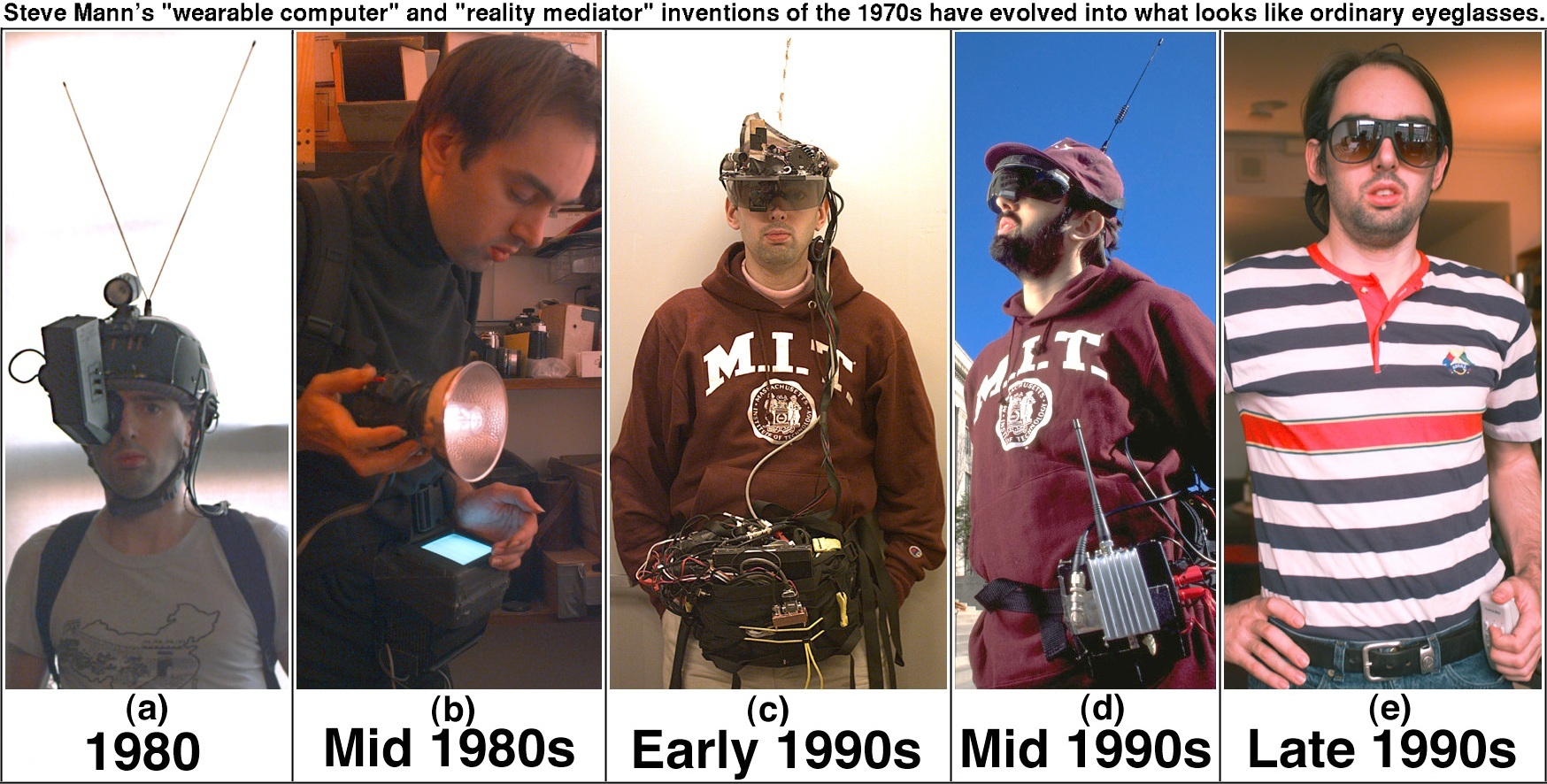
Note the sartorial elegance in this 1980 photo of Steve Mann, "The Father of Wearable Computing":
http://wearcam.org/steve5.jpg
https://wearcam.org/
http://en.wikipedia.org/wiki/Steve_Mann_(inventor)P.S. His related 2001 book "Intelligent Image Processing" was innovative; seminal; excellent.
http://wearcam.org/textbook.htmHe also wrote the 2001 "Cyborg: Digital Destiny and Human Possibility in the Age of the Wearable Computer" but I never read it.
P.S. I'm puzzled why the above jpg isn't showing up inline without clicking it.
-
Embed this notice
DougMerritt (log😅 = 💧log😄) (dougmerritt@mathstodon.xyz)'s status on Friday, 17-Jan-2025 06:33:08 JST
DougMerritt (log😅 = 💧log😄)
@screwtape @josephholsten @smashedratonpress
I had an enlightened history teacher in high school. He started us off reading an essay called "History as a Branch of Fiction"

 All GNU social JP content and data are available under the