GNU social JP
  • FAQ
  • Login
GNU social JPは日本のGNU socialサーバーです。
Usage/ToS/admin/test/Pleroma FE
  • Public

    • Public
    • Network
    • Groups
    • Featured
    • Popular
    • People

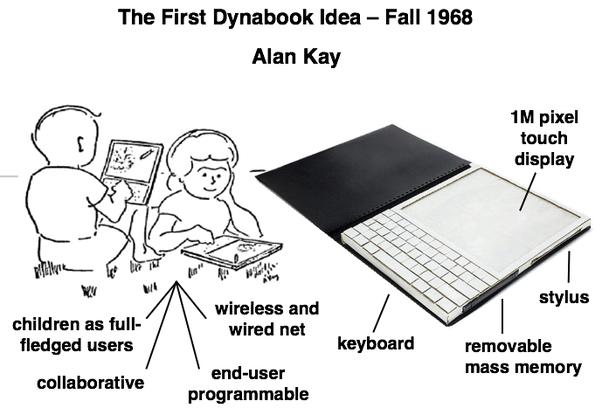
The First Dynabook Idea — Fall 1968. Alan Kay. Sketch of children using the device, with these labels: children as full-fledge users, collaborative, wireless and wired net, end-user programmable. Mockup of device, with these labels: 1M pixel touch display, stylus, keyboard, removable mass memory.

Download link

https://media.hachyderm.io/media_attachments/files/116/851/576/591/353/751/original/7ae643ea7713cb63.jpeg

Notices where this attachment appears

  1. Embed this notice
    Paul Cantrell (inthehands@hachyderm.io)'s status on Friday, 03-Jul-2026 02:32:45 JST Paul Cantrell Paul Cantrell
    in reply to

    Alan Kay’s original “Dynabook” vision superficially resembles modern laptops and tablets — uncannily resembles in many ways! — but it’s the opposite in one important respect:

    Our modern devices are beautifully designed, hermetically sealed products in which there is a strong vendor / user hierarchy.

    The Dynabook, as I understand it, would be the opposite of hermetically sealed. It arrives not as a finished design, but as a starting point. Embedded in that “for children” ethos is the idea of play, tinkering, scribbling, making a mess and cleaning it up — and thus the idea of devices being •reshapable•.

    (Image source, with lots of commentary from Kay: https://www.quora.com/American-computer-pioneer-Alan-Kay-s-concept-the-Dynabook-was-published-in-1972-How-come-Steve-Jobs-and-Apple-iPad-get-the-credit-for-tablet-invention/answer/Alan-Kay-11)

    5/

    In conversation about 4 months ago from hachyderm.io permalink
  • Help
  • About
  • FAQ
  • TOS
  • Privacy
  • Source
  • Version
  • Contact

GNU social JP is a social network, courtesy of GNU social JP管理人. It runs on GNU social, version 2.0.2-dev, available under the GNU Affero General Public License.

Creative Commons Attribution 3.0 All GNU social JP content and data are available under the Creative Commons Attribution 3.0 license.