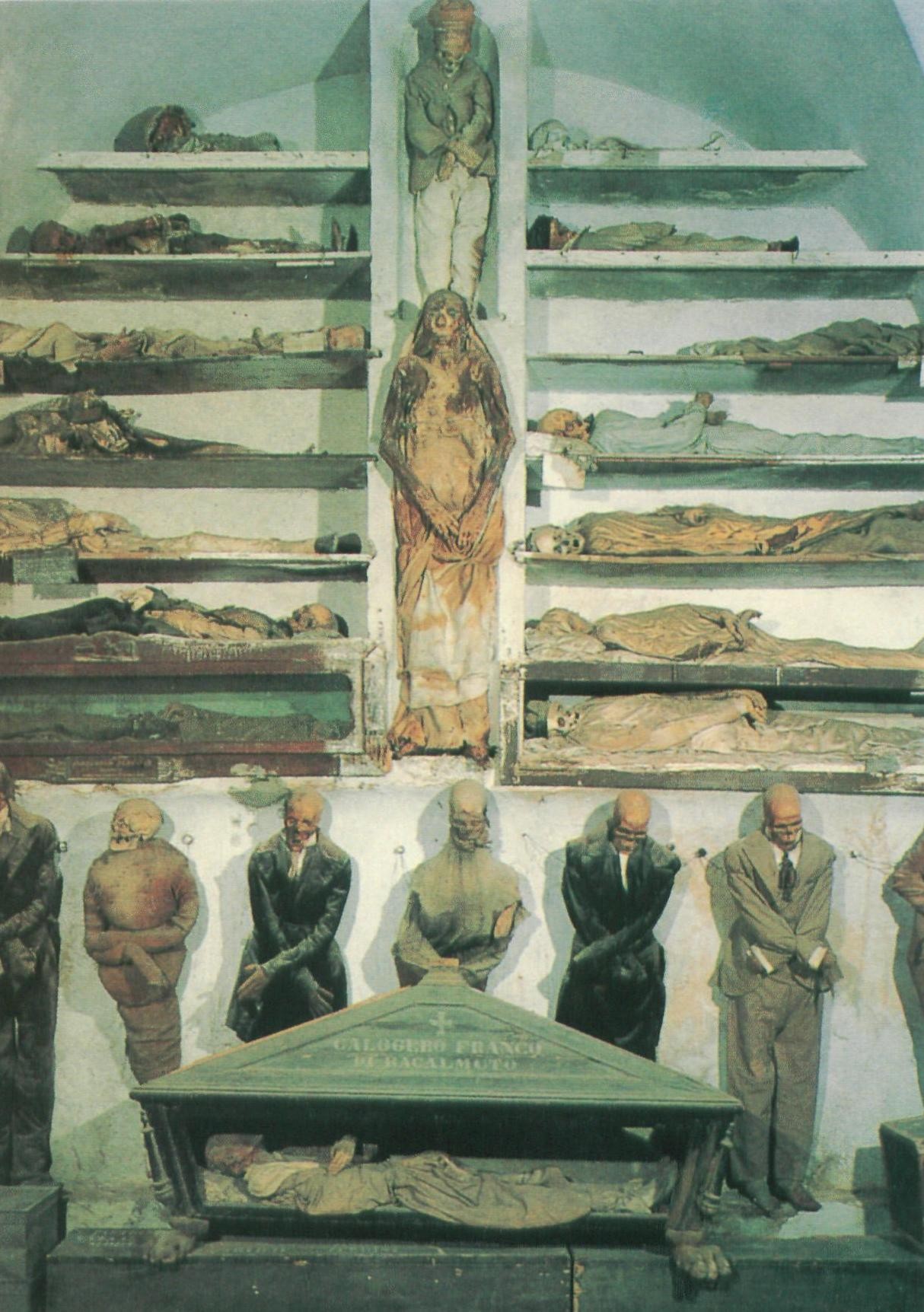
men's corridor. skeletons watch over the vip. cadavers sleep on shelves behind
https://cdn.social.linux.pizza/system/media_attachments/files/116/342/026/815/185/517/original/de4132e2d5381af5.jpg

 𝗘𝗻𝗮ʳ𝑔𝑒𝑖𝑎
The Capuchin Catacombs (also Catacombe dei Cappuccini) of Palermo, Sicily, southern Italy. The monastery outgrew its original cemetery in the 16th century, and the monks began excavating crypts under it, eventually placing within those among them who died in the process.
They contain about 8,000 corpses and 1,252 mummies (as stated by EURAC census in 2011) that line the walls. The halls are divided by category: men, women, virgins, children, priests, monks, and professionals. Some bodies are better preserved than others. Some are set in poses; for example, two children sit together in a rocking chair. The coffins were accessible to the families of the deceased so that on certain days the family, including the deceased, could join their hands in prayer.
Initially they were intended only for deceased friars. However, in later centuries it became a status symbol to be entombed here. In their wills, local luminaries would ask to be preserved in certain clothes, or even have their clothes changed at regular intervals. Priests wore their clerical vestments, while others were clothed according to contemporary fashion.
The catacombs were maintained through donations from the relatives of the deceased. Each new body was placed in a temporary niche and later placed into a more permanent location. So long as contributions continued, the body remained in its proper place, but if relatives stopped sending money, the body was put aside on a shelf until they resumed payments.
GNU social JP is a social network, courtesy of GNU social JP管理人. It runs on GNU social, version 2.0.2-dev, available under the GNU Affero General Public License.
 All GNU social JP content and data are available under the Creative Commons Attribution 3.0 license.