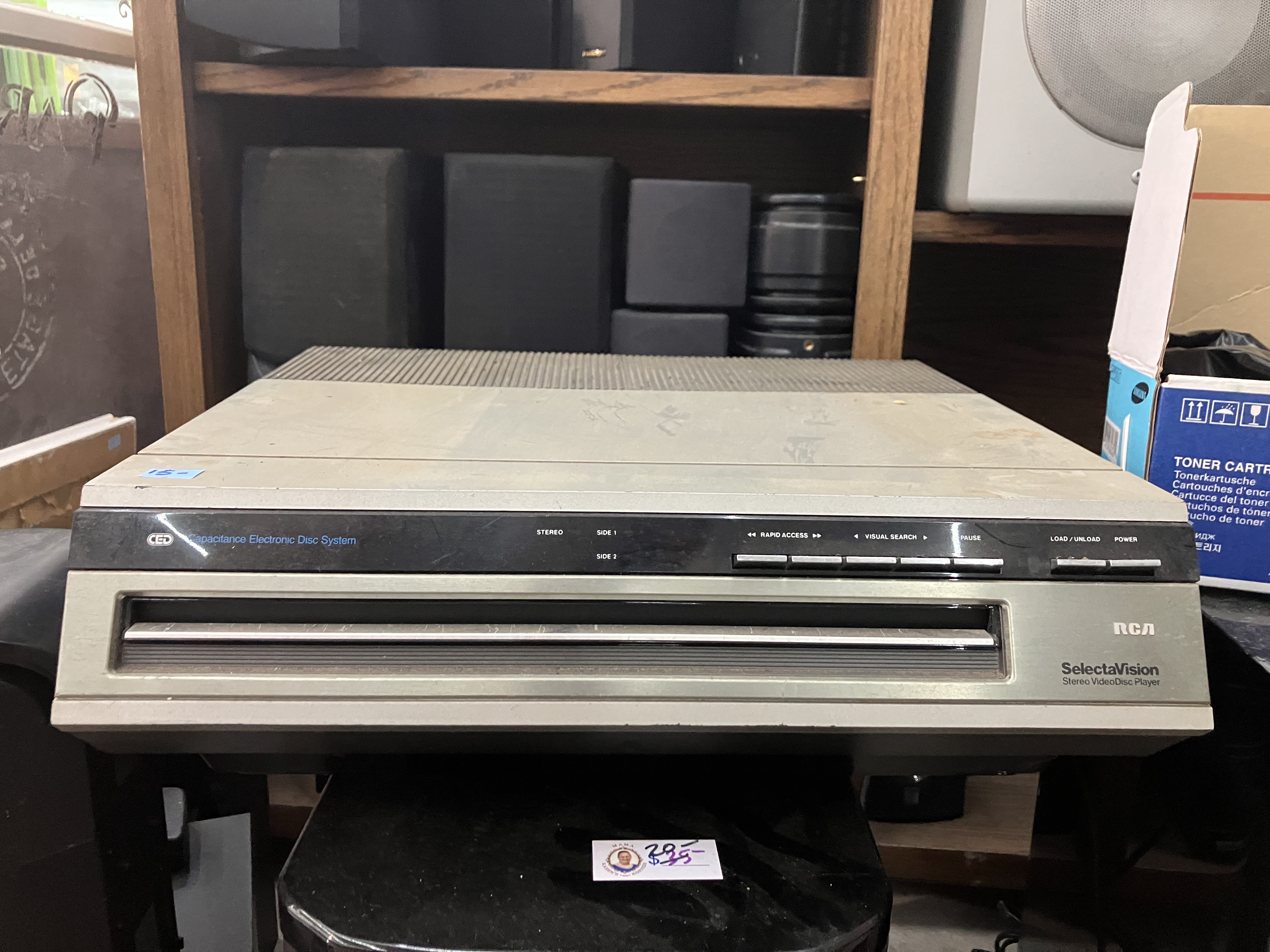
A dusty silver-and-black RCA SelectaVision CED video disc player sits on a small black stand in front of a wooden media cabinet. The front panel features a long disc-loading slot, push buttons for rapid access, visual search, pause, load/unload, and power, along with labels reading “Capacitance Electronic Disc System” and “Stereo VideoDisc Player.” The top surface shows visible wear, dust, and faded markings. Behind the player are several black speakers and camera lenses stored on the cabinet shelves, with a white speaker visible in the upper-right corner. A toner cartridge box sits to the right of the unit.
Notices where this attachment appears
-
Embed this notice
This is a RCA SelectaVision CED video disc player.
It’s selling for $15 at a thrift store—so I must buy it.
Why my excitement? Because this absolute unit plays the ill-fated CED (Capacitance Electronic Disc) format.
In terms of tech, CED is mind-boggling: it’s a vinyl record for video.
Inside that slot goes a massive plastic caddy containing a 12-inch vinyl disc. When you push the caddy in and pull it out, the bare disc is left inside the machine. Unlike LaserDisc (which used lasers to read data optically), CED was an analog, mechanical system. It used a diamond stylus riding in microscopic grooves, akin to a standard phonograph record.
The story behind this machine is one of the greatest, most tragic in AV history—and directly led to the decline of RCA.
It took RCA 17 years to design CED. By 1981, they spent $200M—thats $732.7M after inflation—on R&D of this product.
Maybe it would have been a success if CED released in 1964, when they first started work on it. But by the time it came to market, it was competing against VHS, BetaMax, and LaserDisc.
And while CEDs were cheaper to manufacture in 1981 compared to all the other home video formats, it was the most prone to failure. While it looked better than VHS under ideal situations, the reality was usually less than ideal. Just a little bit of dust caused the video to skip, loop, or violently glitch.
The death knell for CED was the drastic fall in price of Beta and VHS. Their superior quality, combined with the ability to record, proved devastating for RCA.
All CED players were pulled from the market by 1984, three years after their introduction. RCA would soon no longer be a major tech company. This SelectaVision is a remnant of that history.

 Chris Trottier
 All GNU social JP content and data are available under the