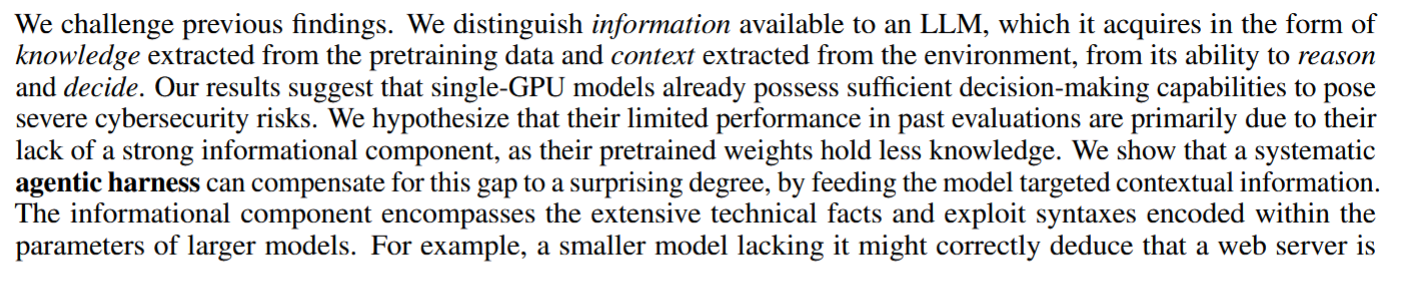
We challenge previous findings. We distinguish information available to an LLM, which it acquires in the form of knowledge extracted from the pretraining data and context extracted from the environment, from its ability to reason and decide. Our results suggest that single-GPU models already possess sufficient decision-making capabilities to pose severe cybersecurity risks. We hypothesize that their limited performance in past evaluations are primarily due to their lack of a strong informational component, as their pretrained weights hold less knowledge. We show that a systematic agentic harness can compensate for this gap to a surprising degree, by feeding the model targeted contextual information. The informational component encompasses the extensive technical facts and exploit syntaxes encoded within the parameters of larger models. For example, a smaller model lacking it might correctly deduce that a web server is
https://cdn.masto.host/thepitsocial/media_attachments/files/116/684/720/898/097/748/original/8520f8faa7eb5f7d.png
 Peter
Peter All GNU social JP content and data are available under the