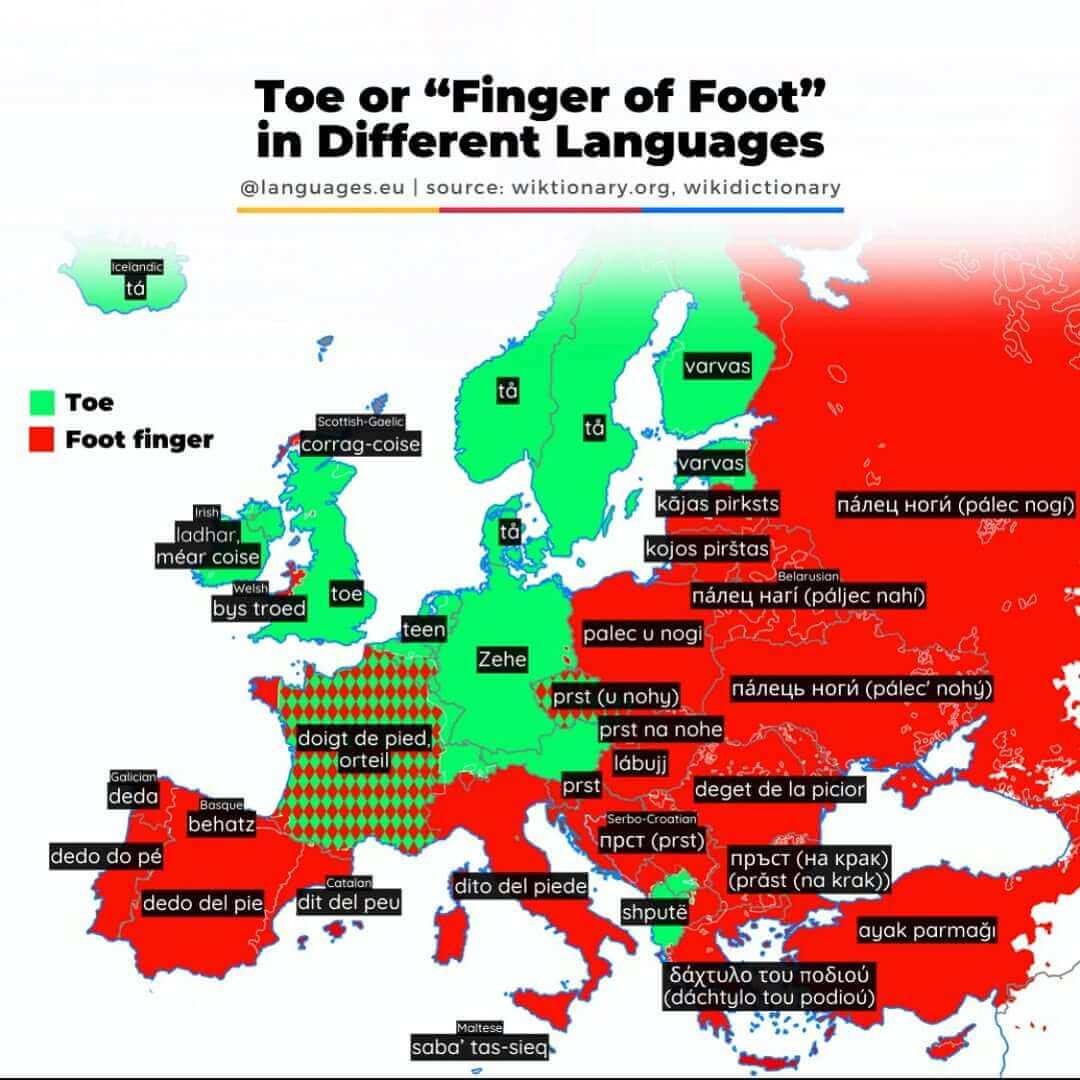
A colorful linguistic map of Europe titled “Toe or ‘Finger of Foot’ in Different Languages” comparing how different languages name the body part “toe.” A legend indicates green areas use a distinct word meaning “toe” while red areas use a compound term meaning “foot finger.” Northern Europe including the UK, Ireland, Scandinavia, and parts of Germany and the Netherlands are shaded green, with labels such as English “toe,” German “Zehe,” Welsh “bys troed,” Irish “ladhar méar coise,” and Scandinavian forms like “tå.” In contrast much of southern and eastern Europe is shaded red, showing languages that literally translate to “finger of the foot,” including Spanish “dedo del pie,” Portuguese “dedo do pé,” Italian “dito del piede,” Greek “δάχτυλο του ποδιού,” Turkish “ayak parmağı,” and Slavic languages such as Russian “палец ноги” and Polish “palec u nogi.” France appears with a mixed patterned area indicating variation, labeled with both “orteil” and “doigt de pied.” Smaller labels mark regional languages such as Basque “behatz,” Catalan “dit del peu,” and Maltese “saba’ tas-sieq.” The map visually highlights a clear geographic divide, with northern European languages tending to have a single dedicated word for toe, while many southern and eastern languages describe it as a type of finger belonging to the foot.
https://cdn.masto.host/vissocial/media_attachments/files/116/657/730/478/808/431/original/7fed61d743a02445.jpeg
 Information Is Beautiful
 All GNU social JP content and data are available under the