GNU social JP
  • FAQ
  • Login
GNU social JPは日本のGNU socialサーバーです。
Usage/ToS/admin/test/Pleroma FE
  • Public

    • Public
    • Network
    • Groups
    • Featured
    • Popular
    • People

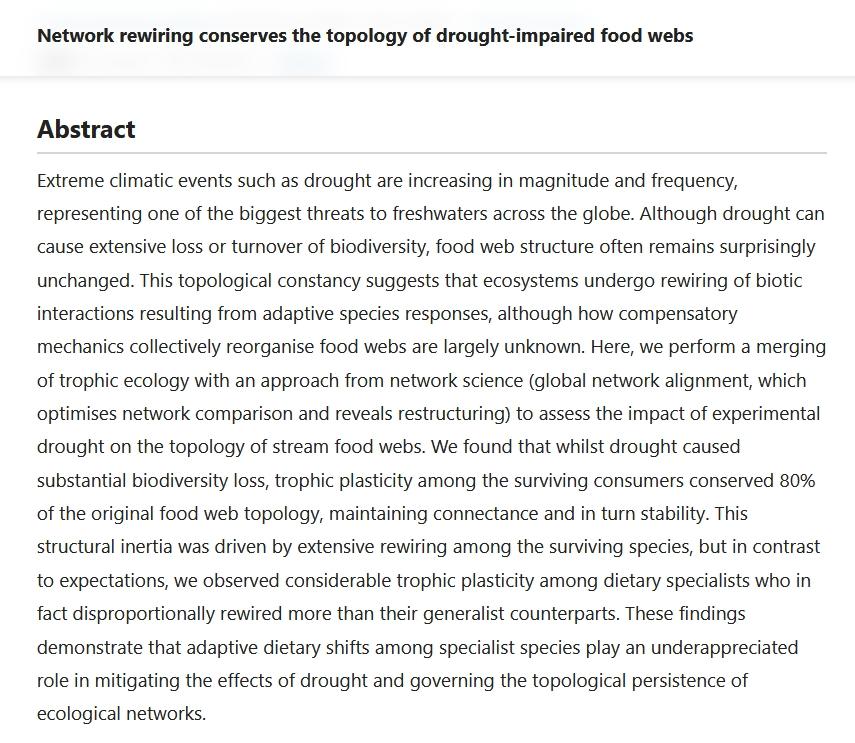
Extreme climatic events such as drought are increasing in magnitude and frequency, representing one of the biggest threats to freshwaters across the globe. Although drought can cause extensive loss or turnover of biodiversity, food web structure often remains surprisingly unchanged. This topological constancy suggests that ecosystems undergo rewiring of biotic interactions resulting from adaptive species responses, although how compensatory mechanics collectively reorganise food webs are largely unknown. Here, we perform a merging of trophic ecology with an approach from network science (global network alignment, which optimises network comparison and reveals restructuring) to assess the impact of experimental drought on the topology of stream food webs. We found that whilst drought caused substantial biodiversity loss, trophic plasticity among the surviving consumers conserved 80% of the original food web topology, maintaining connectance and in turn stability. This structural inertia was driven by extensive rewiring among the surviving species, but in contrast to expectations, we observed considerable trophic plasticity among dietary specialists who in fact disproportionally rewired more than their generalist counterparts. From: Network rewiring conserves the topology of drought-impaired food webs, https://www.nature.com/articles/s42003-025-09035-2

Download link

https://media.mathstodon.xyz/media_attachments/files/116/515/458/665/674/110/original/cb6c49ca77e36e7e.jpg

Notices where this attachment appears

  1. Embed this notice
    John Carlos Baez (johncarlosbaez@mathstodon.xyz)'s status on Thursday, 07-May-2026 03:09:59 JST John Carlos Baez John Carlos Baez
    in reply to

    There is by now a useful quantitative theory of items 7-9 on Meadows’ list: that is, the effects of parameters and feedback loops. There are methods to find feedback loops and predict the response of a system to changes in the strength of its feedback loops [G,Ka], determine which nodes in a network have most control over its overall behavior [LSB], and infer parameters from observed data [ROO].

    Less is known about the more impactful items 5 and 6: that is, the response of a system to changes in its structure, such as adding or removing a feedback loop. Important work has been done, from Mason’s gain formula [Mas], to results putting fundamental limits on what additional feedback loops can achieve [SBG], to work on “food web rewiring” of ecosystems in a changing world [Bar,Ma].

    (5/n)

    [G] Goncalves, P. (2006). Eigenvalue and eigenvector analysis of dynamic systems. Proceedings of the 2006 International System Dynamics Conference. Albany, NY: System Dynamics Society. https://proceedings.systemdynamics.org/2006/proceed/papers/GONCA394.pdf

    [Ka] Kampmann, C.E. (2012). Feedback loop gains and system behavior. System Dynamics Review 28(4), 370–95. https://doi.org/10.1002/sdr.1483

    [Mas] Mason, S.J. (1953). Feedback theory: some properties of signal flow graphs. Proceedings of the IRE 41(9), 1144–56.

    [Bar] Bartley, T.J., et al. (2019). Food web rewiring in a changing world. Nature Ecology & Evolution 3(3), 345-354. https://doi.org/10.1038/s41559-018-0772-3

    [Ma] Ma, A., et al. (2025). Network rewiring conserves the topology of drought-impaired food webs. Communications Biology 8(1), 1641. https://doi.org/10.1038/s42003-025-09035-2

    In conversation about 2 months ago from mathstodon.xyz permalink
  • Help
  • About
  • FAQ
  • TOS
  • Privacy
  • Source
  • Version
  • Contact

GNU social JP is a social network, courtesy of GNU social JP管理人. It runs on GNU social, version 2.0.2-dev, available under the GNU Affero General Public License.

Creative Commons Attribution 3.0 All GNU social JP content and data are available under the Creative Commons Attribution 3.0 license.