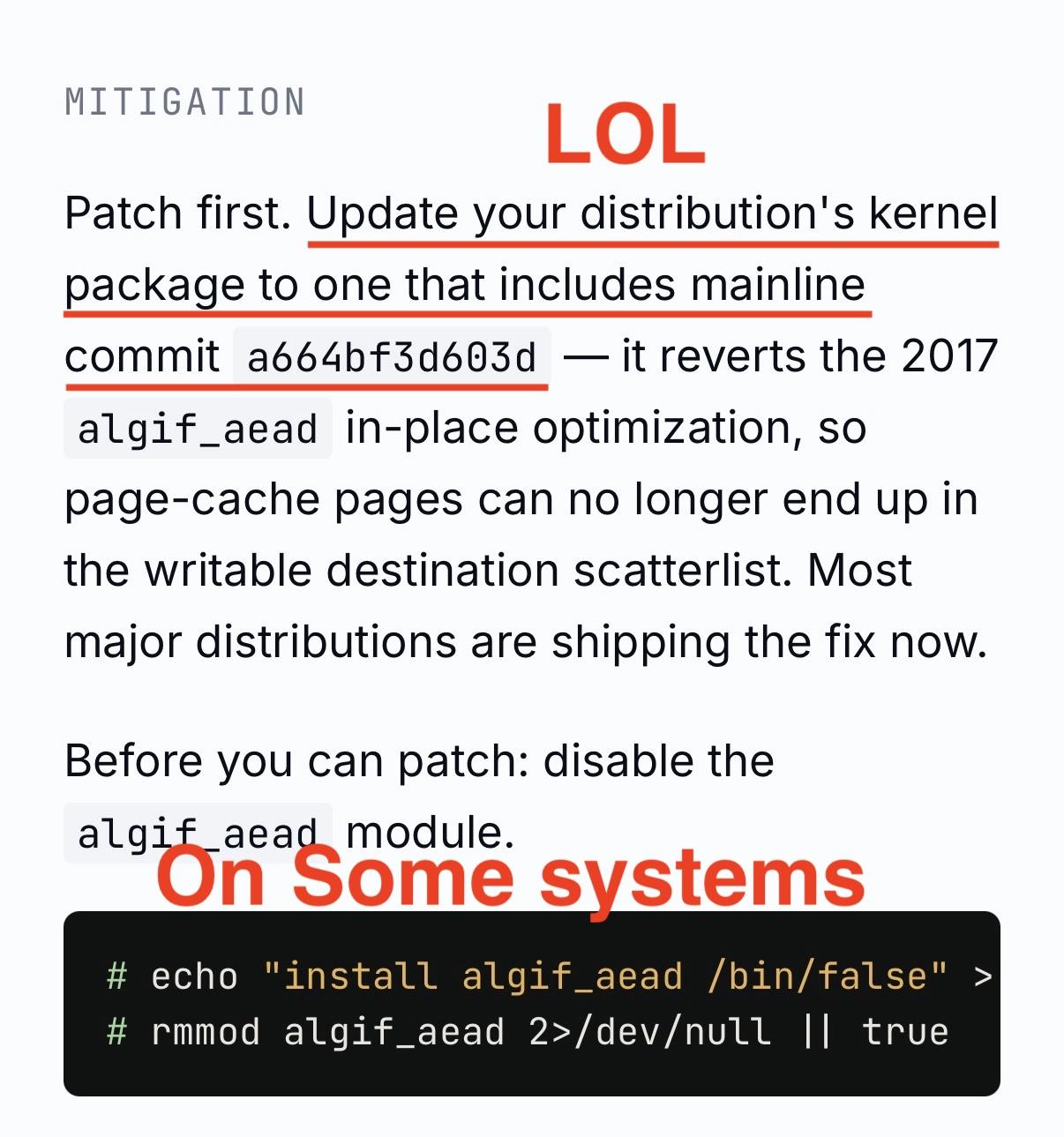
While this vulnerability seems to be discovered using AI ("Xint Code"), I have to assume that they also let the AI decide how to do the vulnerability coordination as well.
major builds are out as of this writing 😂
No distros have official updates for CVE-2026-31431. Fedora 42 and newer have updates, but no official advisory or acknowledgement of CVE-2026-31431. So with them it's unclear if it's even intentional. Red Hat, Ubuntu, Amazon Linux, and Suse all have advisories as of now, but NO updates.
disable the algif_aead module as a mitigation. 😂
Bespoke distros like RHEL don't use a module, it's compiled into the kernel.
I can't figure out what the Xint Code angle is with this copyfail stuff. On one hand, yes, it is a true vulnerability that affects a LOT of Linux distros available. And they did submit the bug for fixing to the upstream kernel people.
BUT the CVE has only existed for a week. And NONE of the distros IN THEIR ADVISORY had updates available at the time that they pulled the trigger for publication of the shiny copy.fail website.
I struggle to think of how this even happens. In all my years of infosec, you're either on board with doing CVD (e.g. coordinating with the former CERT/CC) or you're not (dropping 0day). But this all fits bizarrely in the middle. The publication gives the guise that they did the right thing, (and please use our AI services). But at the same time, they clearly chose to release the vulnerability details and functional exploit before any distro had the ability to properly do anything about it.
Either these Xint Code (Theori) people have a hidden agenda or ulterior motive that we aren't aware of yet. Or they're just really bad at coordinated vulnerability disclosure. You pick.

 Will Dormann
 All GNU social JP content and data are available under the