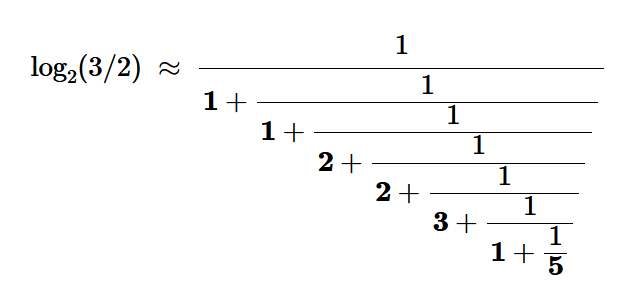
Let's look at this wacky procedure in a more interesting case: when the number in boldface is even bigger, like 5. See below! This fraction is
1/(1 + 1/(1 + 1/(2 + 1/(2 + 1/(3 + 1/(1 + 1/5)))))) = 179/306
The previous fraction on the list is
1/(1 + 1/(1 + 1/(2 + 1/(2 + 1/(3 + 1/1))))) = 31/53
and before that is
1/(1 + 1/(1 + 1/(2 + 1/(2 + 1/3)))) = 24/41
To look for good approximations to log₂(3/2) that aren't on our list, we write down this funny thing:
(31n + 24)/(53n + 41)
Taking n = 0,1,2,3,4,5 this gives 24/41 (on our list), 55/94, 86/147, 117/200, 148/253, 179/306 (on our list).
The four not on our list are new candidates for fractions closer to log₂(3/2) than any fraction with a smaller denominator! But only the last two actually have this good property: 117/200 and 148/253.
In general, when we get an even number of new candidates this way, the last half have this good property. The first half do not.
When we get an odd number of new candidates, it becomes more tricky. The middle one can go either way - but all those after it are closer to log₂(3/2) than any fraction with a smaller denominator, and none before are.
There is a rule to decide this tricky middle case but you've probably had enough by now!
Again: what makes all this stuff worth knowing is that it gives the best rational approximations of *any* positive irrational number, not just log₂(3/2). And this is relevant to resonance problems like the rings of Saturn, which have gaps at orbital periods that are close to simple rational multiples of the periods of the big moons.
(2/n)

 John Carlos Baez
 All GNU social JP content and data are available under the