GNU social JP
  • FAQ
  • Login
GNU social JPは日本のGNU socialサーバーです。
Usage/ToS/admin/test/Pleroma FE
  • Public

    • Public
    • Network
    • Groups
    • Featured
    • Popular
    • People

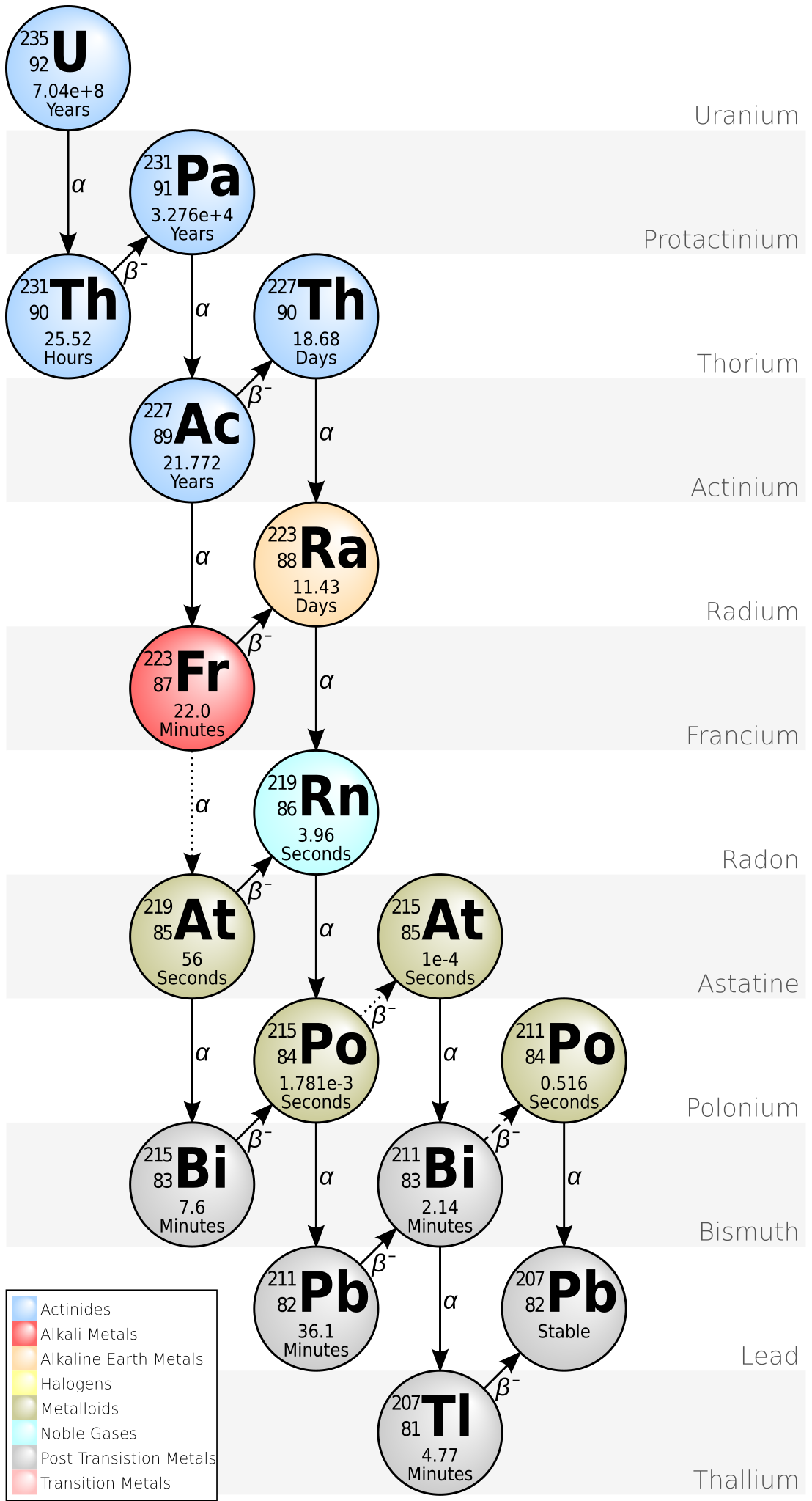
A chart of elements starting with uranium-235 and containing elements with atomic mass 4n+3. U-235 decays to thorium-231 by emitting an alpha particle, thorium-231 decays to protactinium-231 by emitting a beta particle, protactinium-231 decays to actinium-227 by emitting a beta particle, and so on, eventually leading to lead-207. From here: https://commons.wikimedia.org/wiki/File:Decay_Chain_of_Actinium.svg created by Edgar Bonet and placed under a Creative Commons Attribution-Share Alike 3.0 Unported license.

Download link

https://media.mathstodon.xyz/media_attachments/files/115/490/670/971/708/945/original/4b302ee92597df2a.png

Notices where this attachment appears

  1. Embed this notice
    John Carlos Baez (johncarlosbaez@mathstodon.xyz)'s status on Tuesday, 04-Nov-2025 18:58:48 JST John Carlos Baez John Carlos Baez
    in reply to

    Here you can see what Meitner was studying: the decay chain that produces first actinium and eventually lead. All the nuclei in this decay chain have atomic mass 4n+3. The reason:

    • In "α decay" a nucleus emits a helium nucleus or "α particle" - 2 protons and 2 neutrons - so its atomic number goes down by 2 and its atomic mass goes down by 4.

    • In "β decay" a neutron decays into a proton and emits a neutrino and an electron, or "β particle", so its atomic number goes up by 1 and its atomic mass stays the same.

    But to understand Meitner's work in context, you have to realize that these facts only became clear through painstaking work and brilliant leaps of intuition! Much of the work was done by her team in Berlin, Marie and Pierre Curie in France, Ernest Rutherford's group in Manchester and later Cambridge, and eventually Enrico Fermi's group in Rome.

    At first people thought electrons were bound in a nondescript jelly of positive charge - Thomson's "plum pudding" atom. Even when Rutherford, Geiger and Marsden shot α particles at atoms in 1909 and learned from how they bounced back that the positive charge was concentrated in a small "nucleus", there remained the puzzle of what this nucleus was!

    (2/n)

    In conversation about 9 months ago from mathstodon.xyz permalink
  • Help
  • About
  • FAQ
  • TOS
  • Privacy
  • Source
  • Version
  • Contact

GNU social JP is a social network, courtesy of GNU social JP管理人. It runs on GNU social, version 2.0.2-dev, available under the GNU Affero General Public License.

Creative Commons Attribution 3.0 All GNU social JP content and data are available under the Creative Commons Attribution 3.0 license.