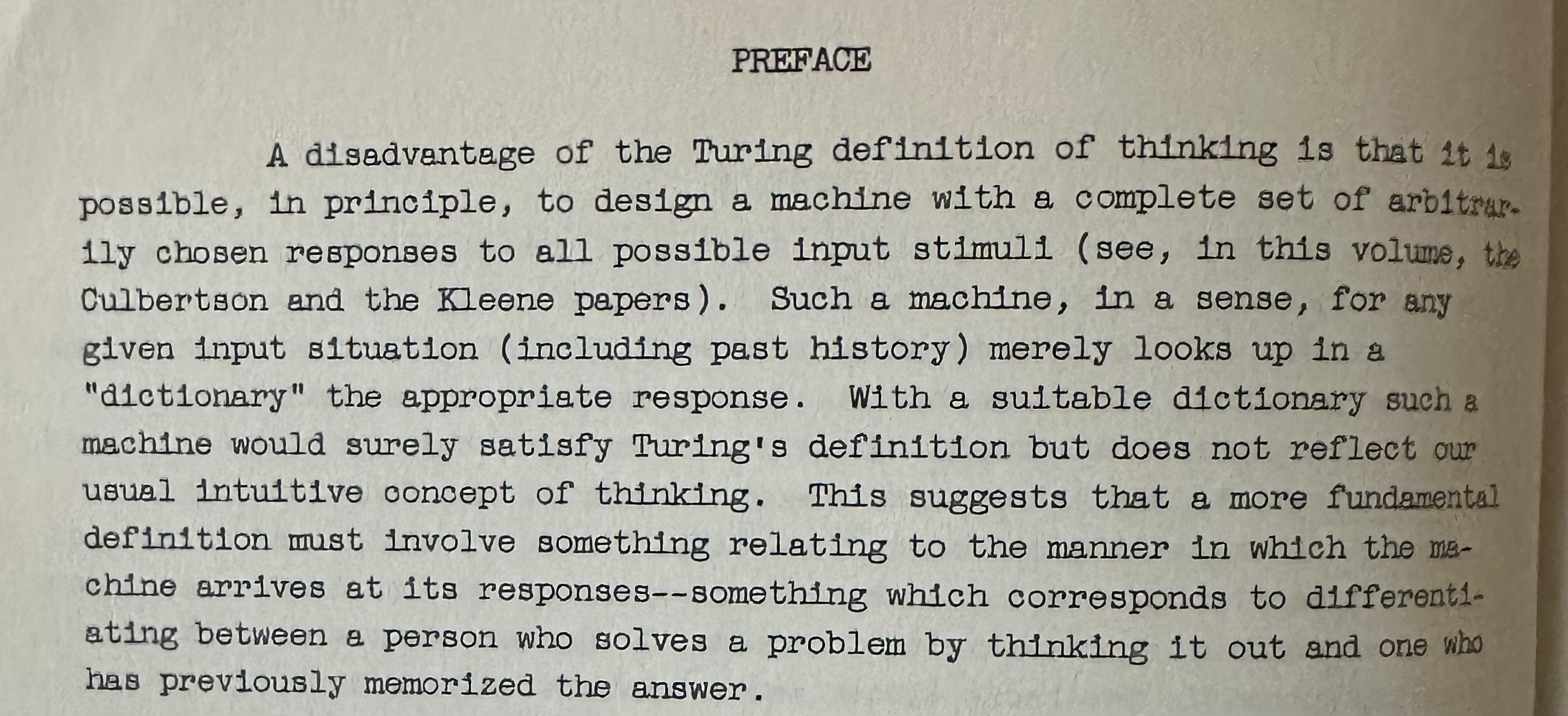
A disadvantage of the Turing definition of thinking is that it is possible, in principle, to design a machine with a complete set of arbitrarily chosen responses to all possible input stimuli (see, In this volume, the Culbertson and the Kleene papers). Such a machine, in a sense, for any given input situation (including past history) merely looks up in a "dictionary" the appropriate response. With a suitable dictionary such a machine would surely satisfy Turing's definition but does not reflect our usual intuitive concept of thinking. This suggests that a more fundamental definition must involve something relating to the manner in which the machine arrives at its responses--something which corresponds to differentiating between a person who solves a problem by thinking it out and one who has previously memorized the answer.
https://files.mastodon.social/media_attachments/files/114/673/212/968/690/388/original/89894a24038b8e74.jpeg
 vy
vy All GNU social JP content and data are available under the