GNU social JP
  • FAQ
  • Login
GNU social JPは日本のGNU socialサーバーです。
Usage/ToS/admin/test/Pleroma FE
  • Public

    • Public
    • Network
    • Groups
    • Featured
    • Popular
    • People

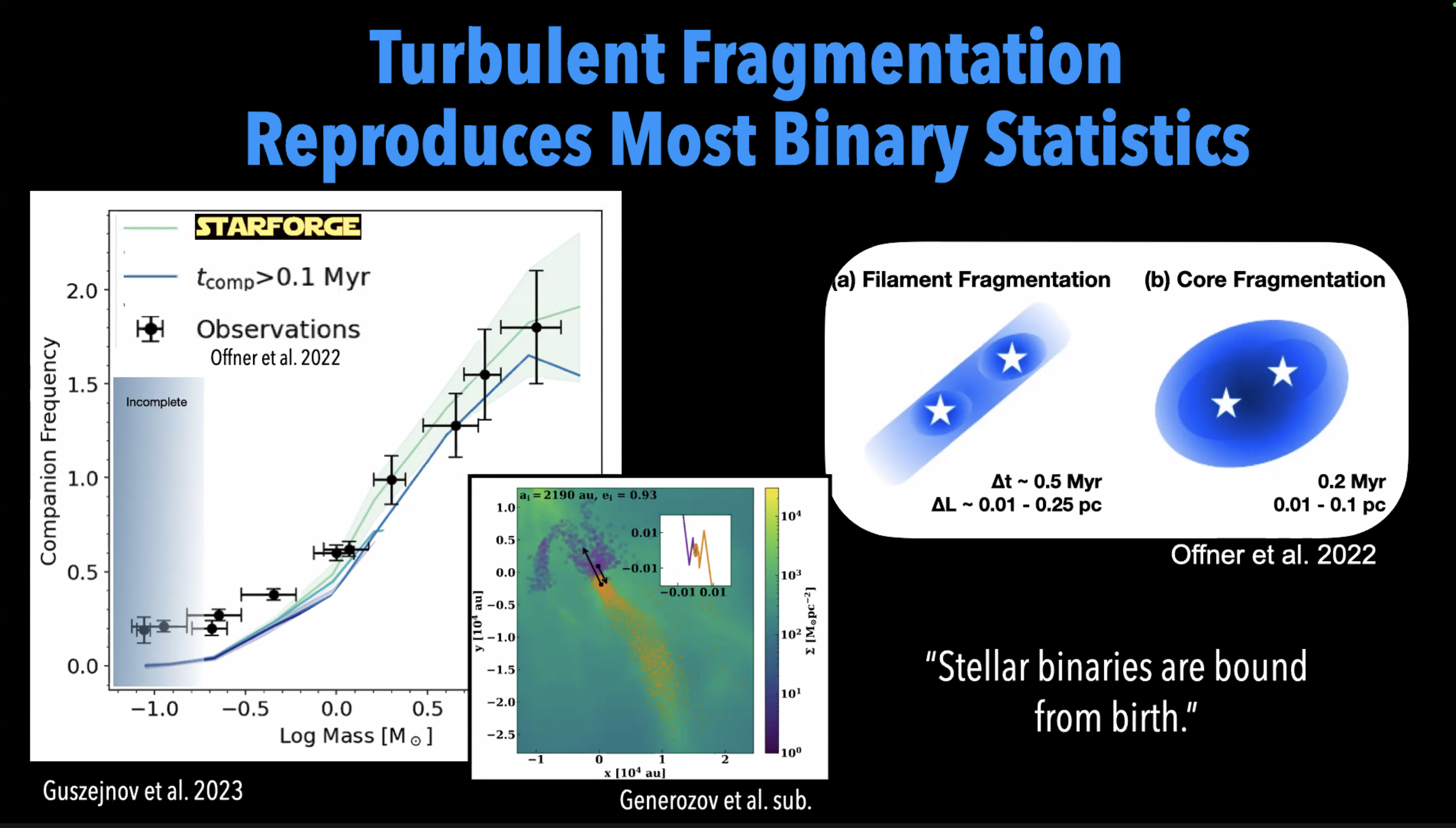
Turbulent Fragmentation Reproduces Most Binary Statistics Plot showing the Companion Frequency vs. Log Mass [M]. Observations are plotted as black dots with error bars. There are very few companions at the low-mass end and a high number of companions at the high mass end. Starforge simulations are plotted as a green line. They are consistent with the data points. Illustrations of (a) Filament Fragmentation: Delta t~0.5 Myr, Delta L~0.01-0.25 pc (b) Core Fragmentation: 0.2 Myr, 0.01-0.1 pc. "Stellar binaries are bound from birth."

Download link

https://media.astrodon.social/media_attachments/files/113/852/816/017/285/090/original/72c1aa5b3b72f5a3.png

Notices where this attachment appears

  1. Embed this notice
    Kelly Lepo (kellylepo@astrodon.social)'s status on Tuesday, 21-Jan-2025 01:35:10 JST Kelly Lepo Kelly Lepo
    in reply to

    It can also create the correct distribution of binary stars with just turbulent fragmentation of the clouds of gas — meaning the stars have always formed a binary pair, they were not captured later.

    STARFORGE also tells us that very small clouds will not form high-mass stars.

    In conversation Tuesday, 21-Jan-2025 01:35:10 JST from astrodon.social permalink
  • Help
  • About
  • FAQ
  • TOS
  • Privacy
  • Source
  • Version
  • Contact

GNU social JP is a social network, courtesy of GNU social JP管理人. It runs on GNU social, version 2.0.2-dev, available under the GNU Affero General Public License.

Creative Commons Attribution 3.0 All GNU social JP content and data are available under the Creative Commons Attribution 3.0 license.