GNU social JP
  • FAQ
  • Login
GNU social JPは日本のGNU socialサーバーです。
Usage/ToS/admin/test/Pleroma FE
  • Public

    • Public
    • Network
    • Groups
    • Featured
    • Popular
    • People

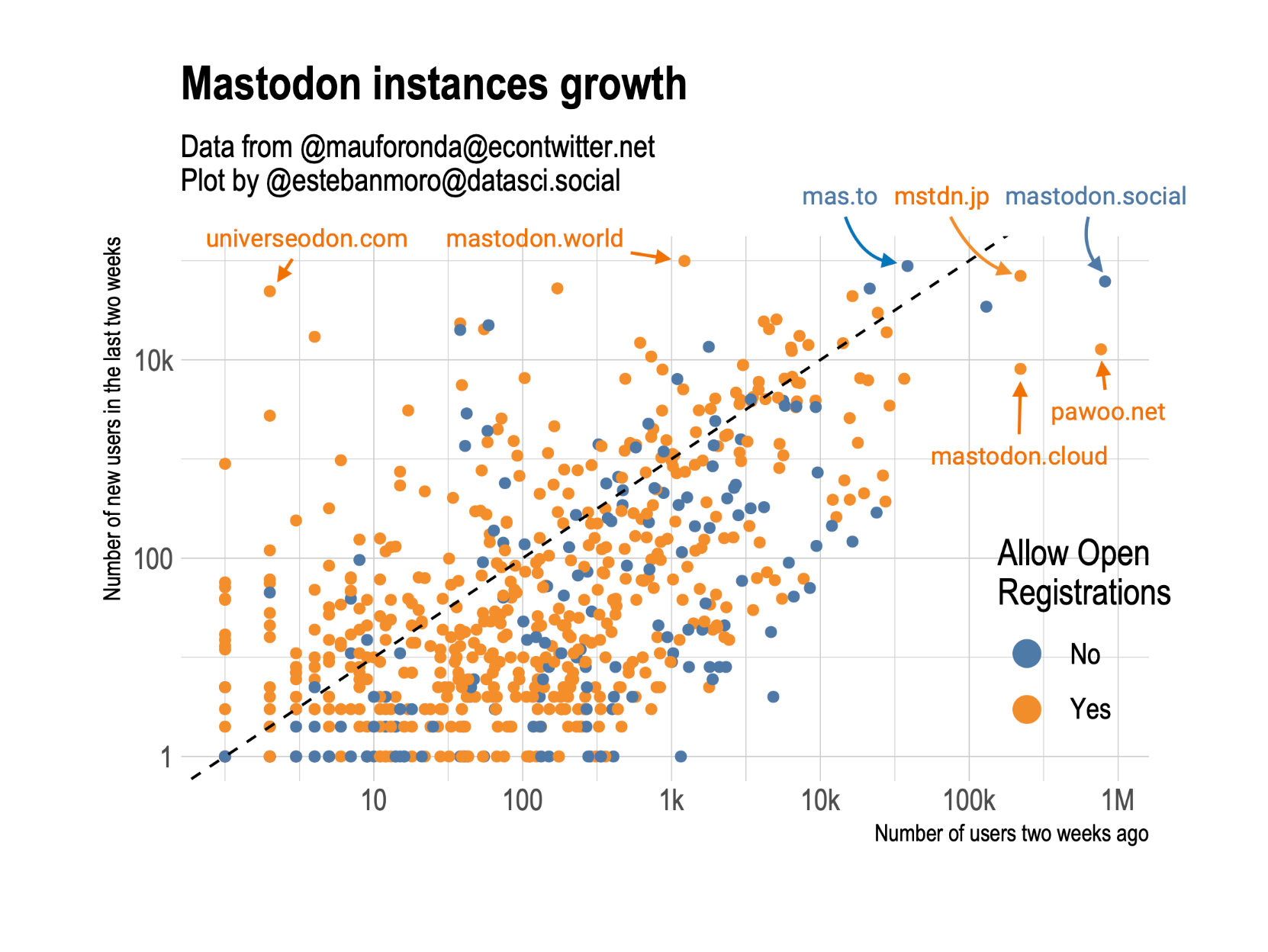
The plot shows the relationship between the number of users each instance in mastodon had two weeks ago (horizontal axis) versus the number of new users in the last two weeks (vertical axis). Each point correspond to a instance. We can see that there is a relationship between them, meaning that the "rich-get-richer". However, the most rapidly-growing instances are Mastodon.world and mas.to which are not the biggest.

Download link

https://sb-82bx3xp8al.b-cdn.net/media_attachments/files/109/383/878/037/428/740/original/4ce8185f8a047933.png

Notices where this attachment appears

  1. Embed this notice
    Esteban Moro (estebanmoro@datasci.social)'s status on Tuesday, 22-Nov-2022 09:51:08 JST Esteban Moro Esteban Moro

    The number of users by instance in #mastodon is highly unequal. Some servers (mastodon.social) have a significant fraction of the number of users. If the ubiquitous "rich-get-richer" (RGR) phenomenon kicks in, we might end up with a couple of instances having all of the users. But did it kick in? Here is the relationship between instance's size and growth. There is a little bit of RGR, but some of the rapidly-growing instances are small. Decentralization also in how the network grows.

    In conversation Tuesday, 22-Nov-2022 09:51:08 JST from datasci.social permalink
  • Help
  • About
  • FAQ
  • TOS
  • Privacy
  • Source
  • Version
  • Contact

GNU social JP is a social network, courtesy of GNU social JP管理人. It runs on GNU social, version 2.0.2-dev, available under the GNU Affero General Public License.

Creative Commons Attribution 3.0 All GNU social JP content and data are available under the Creative Commons Attribution 3.0 license.